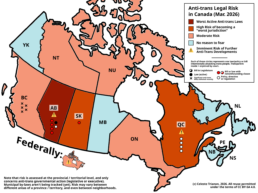
March 2026 Canadian Anti-Trans Legal Risk Assessment Map
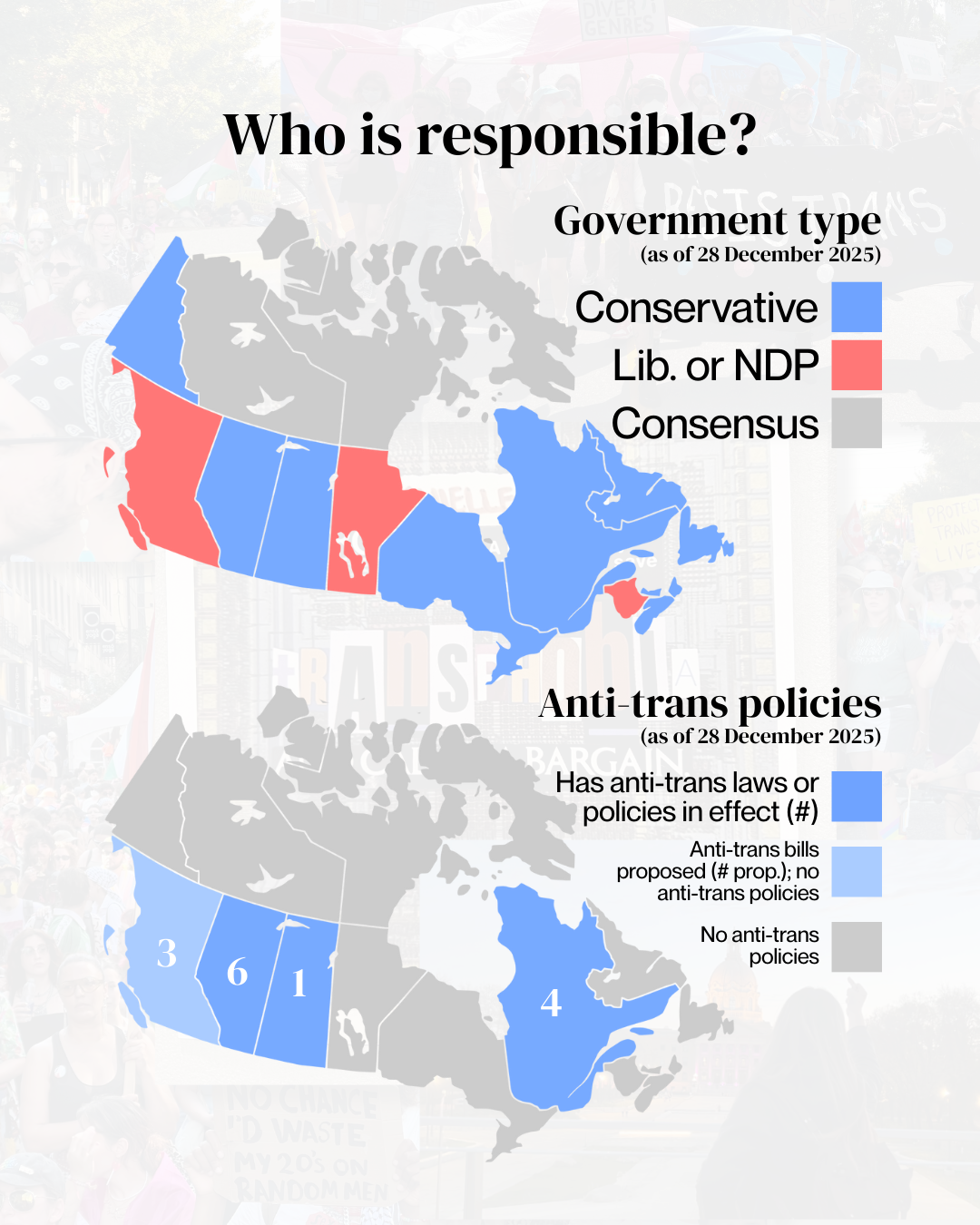
There are no signs that 2026 will bring a slowdown in anti-trans legislation across Canada. While no new bills have become law since Alberta Bill 26/9 back in December 2025, new bills threatening trans youth and adults, some of which have reached degrees of extremism arguably even worse than in the United States, have regardless been introduced.
New to this update: every province will be tagged with a list of active anti-trans legislation and/or policies either in consideration or in effect. You can use this to make your own assessments.
Changes since July 2025
- Québec: Medium/High risk → High risk
- PEI and Nova Scotia: Moderate risk → “No reason to fear”
- All “low risk” provinces and Yukon have been re-categorized as “No reason to fear”
- Northwest Territories: Low risk → Medium risk
- Nunavut: Categorized as Medium risk
About this map
Since I began tracking anti-trans developments in Canada (as early as 2021, when I was fighting against the initial iteration of Québec Bill 2), I’ve had people ask me: “I’m planning on moving to Canada, where should I move?”. This question, unfortunately, has been asked to me way too many times since January 2025, when Donald Trump seized power in the United States: promptly, our southern neighbours have become a no-go zone for trans people, with hundreds of thousands of internally displaced persons and (increasingly) refugees and de facto refugees. This question is equally relevant to trans Canadians themselves, as well as other trans migrants, who wish to be able to live and thrive in an environment where their existence isn’t consistently questioned.
I created my original anti-trans risk map in September 2023, inspired off of Erin Reed’s anti-trans risk map (last updated Feb. 2026), as an exercise in visualizing anti-trans hate across Canada. This was when the first concerted efforts to push anti-trans policy in Canada were taking shape, all alongside a tonne of anti-trans protests.
My focus is on documenting risk for both trans youth and adults, with the assumption that both are correlated. Most anti-trans legislation (and anti-2SLGBTQ+ legislation at large), within the Canadian context, either targets trans youth (targeting them either because they are under the age of majority, or because they are attending school) or trans women (see: transmisogyny).
Note: I consider both anti-trans intent and effect. Whilst my focus is still on the former, I will still consider the latter.
Note that this map only tracks legislated hate, and not the relative safety of different communities for trans folk across Canada. Significant judicial decisions will also be mentioned. The unfortunate truth is that it’s extremely difficult to map out, say, the occurrence of hate crimes or other forms of hate. Do not rely on this map as a sole gauge of the state of transphobia in Canada; there are a lot of minute details, sometimes going all the way to the neighbourhood level, which I simply cannot capture in one map!
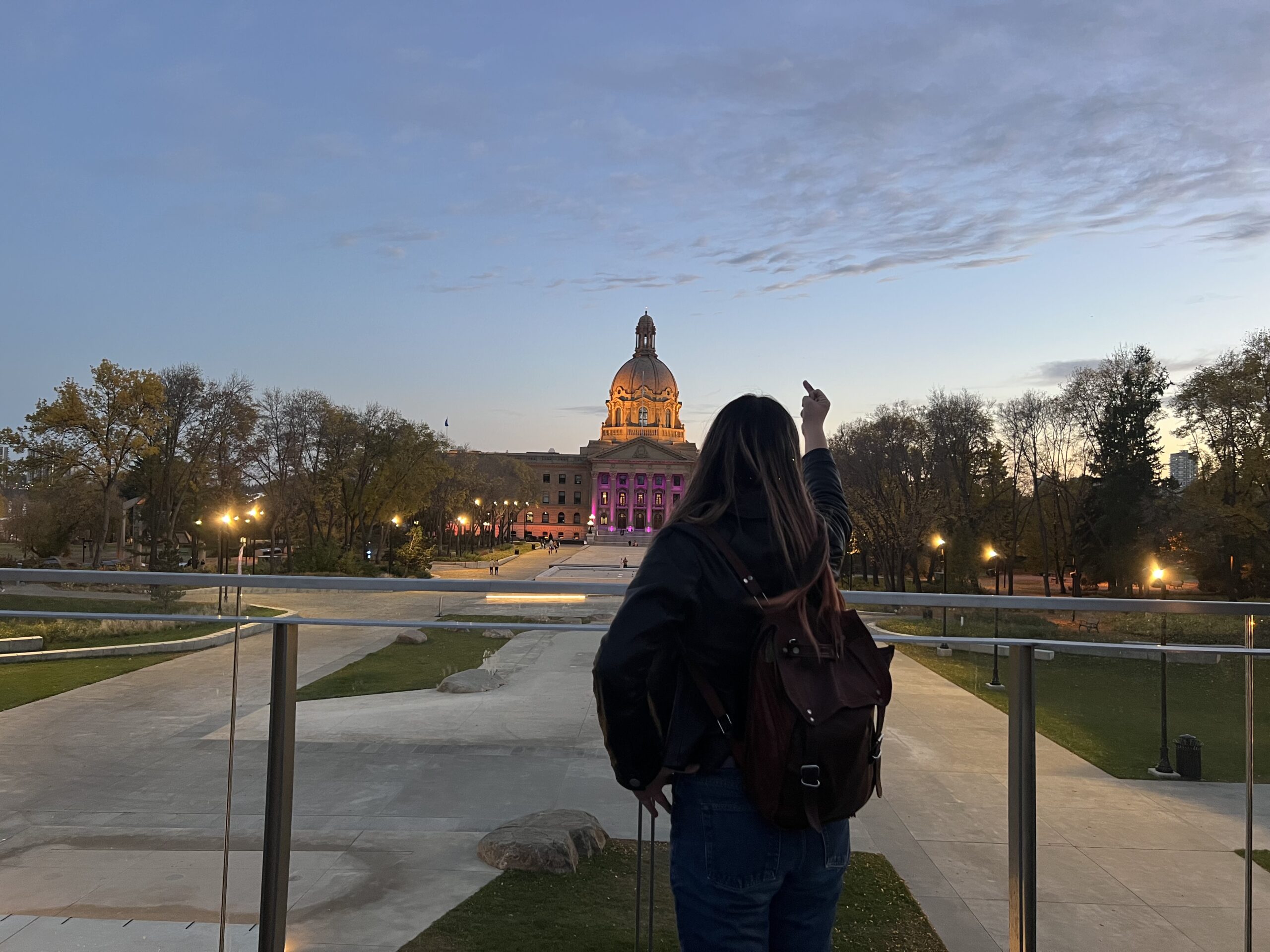
The worst jurisdiction: Alberta
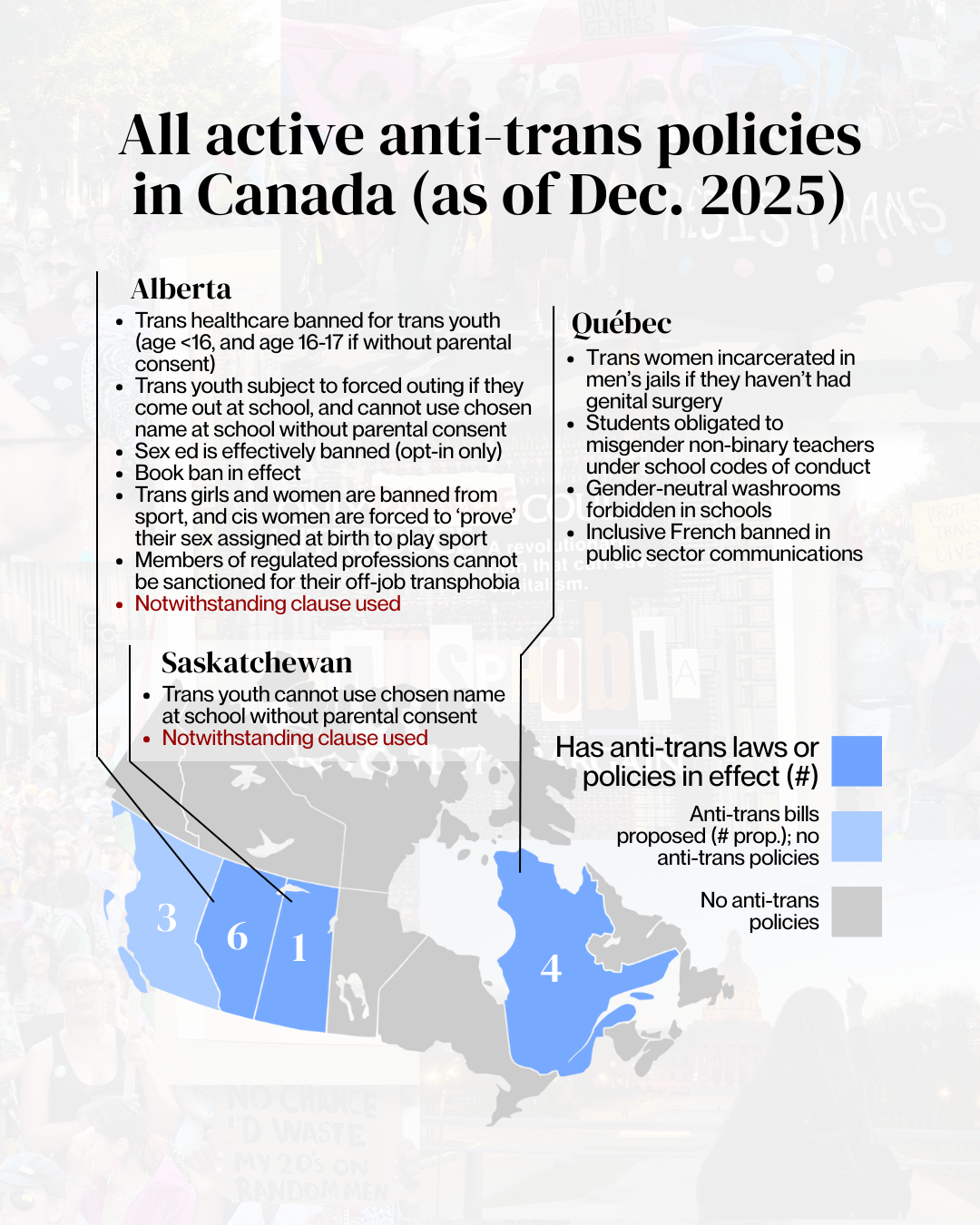
Active policies:
- Gender-affirming care ban for trans youth
- Complete ban (with exceptions) for youth under age 16; 16-17 year olds require parental consent, notwithstanding the mature minor doctrine
- Has been challenged in court, but the Alberta government blocked it using the notwithstanding clause of the Canadian Charter of RIghts and Freedoms — i.e. trans kids in Alberta do not have the right to life insofar as their healthcare is banned
- De facto sex ed ban in schools
- Forced outing of trans youth who come out at school
- Trans youth cannot use chosen name or pronouns at school without parental consent
- Trans girls and women age 12+ are banned from women’s sports, even recreational sports and physical education classes
- Cisgender (non-trans) girls and women age 12+ are required to declare their sex (and in the case of youth, have a form signed by parents attesting their child’s sex) — and can have their presence in women’s sports challenged by gender vigilantes
- Book ban in schools (applies to certain graphic novels only)
- Regulated professions cannot require EDI education and cannot sanction members for transphobia
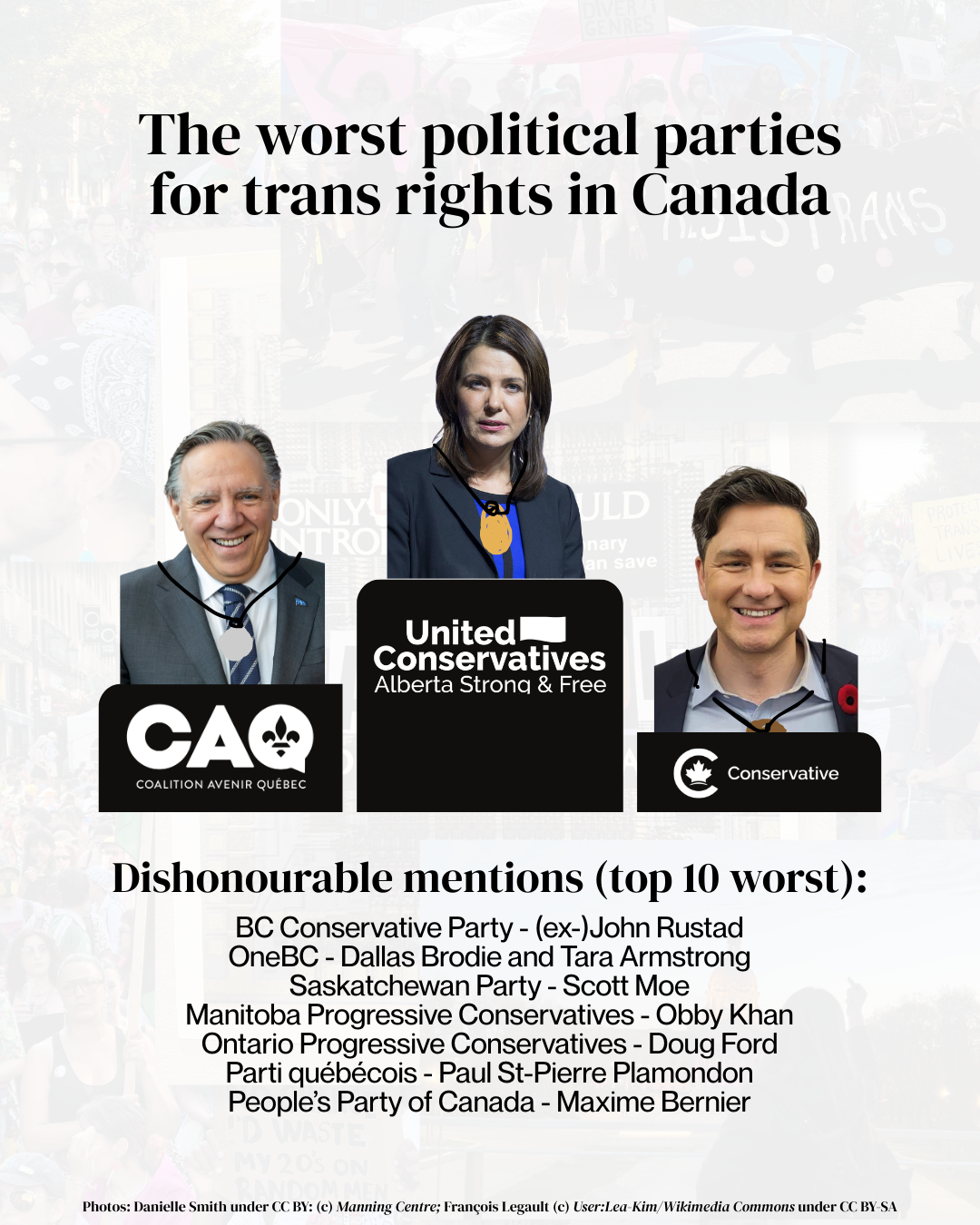
Alberta continues, even into 2026, to be the only Canadian jurisdiction to get the “worst anti-trans laws” label attached to it.
Bill 26, the gender-affirming healthcare ban law, was previously temporarily enjoined in court, thanks to the efforts of Skipping Stone and Égale Canada, which launched a court challenge the day after the bill received royal assent. The Canadian Medical Association has also launched its own lawsuit over said bill. However, the Alberta government has invoked the notwithstanding clause of the Canadian Charter of Rights and Freedoms, a legal provision that allows the government to disregard most of the various human rights that have been protected in Canada since 1982, through Bill 9, the so-called “Protecting Alberta’s Children Statutes Amendment Act”. Since December 19, 2025, gender-affirming healthcare for trans youth in Alberta is banned (with exceptions). The Skipping Stone/Égale lawsuit is still ongoing, though on different juridical grounds.
Bills 27 and 29, making sex ed opt-in-only in schools, forcibly outing trans youth and preventing them from using their names, and preventing trans women and girls from playing sport, have become law on September 1, 2025. They have been modified by Bill 9, to equally incorporate the notwithstanding clause.
Alberta also attempted to introduce a book ban. Initially, this applied to all books, including titles such as The Handmaid’s Tale. Following widespread backlash, the government would reverse course and apply the ban solely to graphic novels.
Bill 13, the Regulated Professions Neutrality Act (also known as the so-called “Jordan Peterson law”, named after the transphobe known for his opposition to granting human rights to trans people), became law on December 11, 2025. So far, the impacts of this law are most obvious with the Law Society of Alberta, which axed its EDI committee in response. The law prohibits professional regulators from punishing its members over their actions outside of the professional context, such as, for example, a doctor who says “trans kids do not exist” on the Internet. Whilst not a law explicitly targeting trans people, it is quite obvious that the United Conservative Party (UCP) introduced this bill for this express purpose.
Note: even though the UCP, the far-right party governing Alberta, has proposed as part of its policy playbook drag bans, gender marker change bans, and further leeway for on-campus hate speech — moves which suggest that Alberta will not back down, no matter what the Canadian Charter of RIghts and Freedoms states — no further developments have taken place on this front.
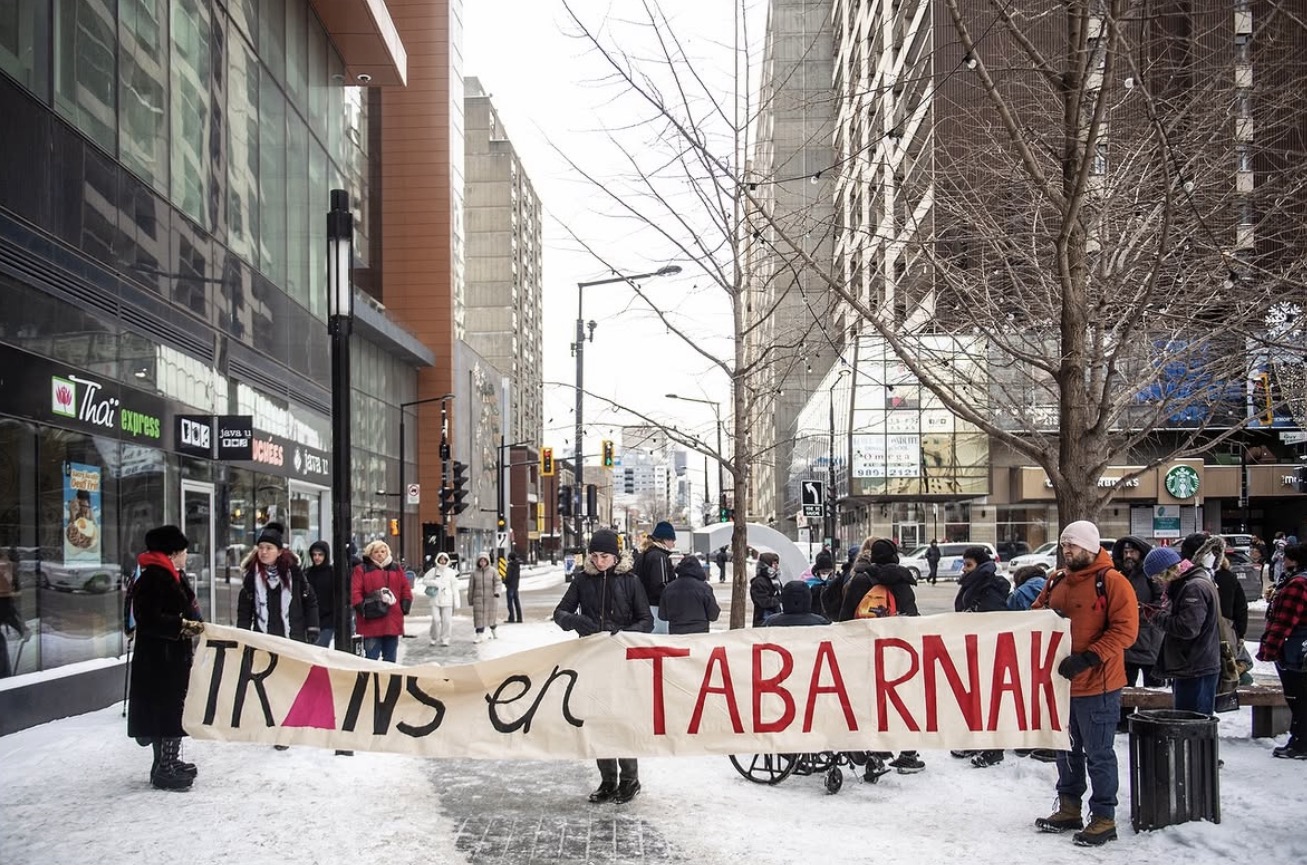
In second place (tied): Québec
Active policies:
- Trans prisoners are assigned to prisons solely according to genitalia
- Trans public servants are forbidden from using inclusive French, including they/them pronouns
- Trans teachers are forced to go by “Mr.” or “Ms.” in schools, to the exclusion of “Mx.” or even “Prof.”
- Schools are prohibited from building gender-neutral washrooms
The only new update in re: policies regarding trans people in Québec since my last update is that trans public servants have been ordered to not use inclusive French. This means that a public sector worker using they/them pronouns (iel in French) is effectively forced to misgender themselves and be misgendered at work.
With regards to trans healthcare, while no bans per se have been announced, the wait times for gender-affirming surgeries for trans adults have tripled owing to government budget cuts.
Three of the five major political parties in Québec (the CAQ (currently governing), PQ (currently leading in the polls), and the PCQ) are currently using transphobia in an attempt to score political points. This includes a recent case where a non-binary person got a $500 judgment against a hair salon, as well as a case of a hospital advertising free HPV (cervix) tests without mentioning the word “woman”; in the latter case, the hospital was ordered by the government to add said word, in spite of how much of a non-issue this is.
There equally is anti-trans litigation active in Québec to allow teachers to out their trans students to their respective parents. Note: I am a party to said case (as the representative for Juritrans, an intervening party).
Overall, the broader context in Québec suggests that further anti-trans developments can occur anytime. As such, Québec’s risk level has been bumped up even higher. The only thing stopping Québec’s risk level from being higher than Saskatchewan is its non-use of the notwithstanding clause against trans people (though, Québec hasn’t hesitated to use it against refugees and Muslim women).
In second place (tied): Saskatchewan
Saskatchewan still forbids trans youth from using their chosen names and pronouns in school without parental consent, and has used the notwithstanding clause to that effect. No further major developments have taken place since my last update.
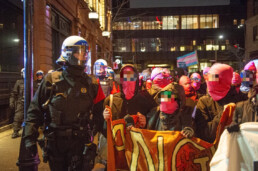
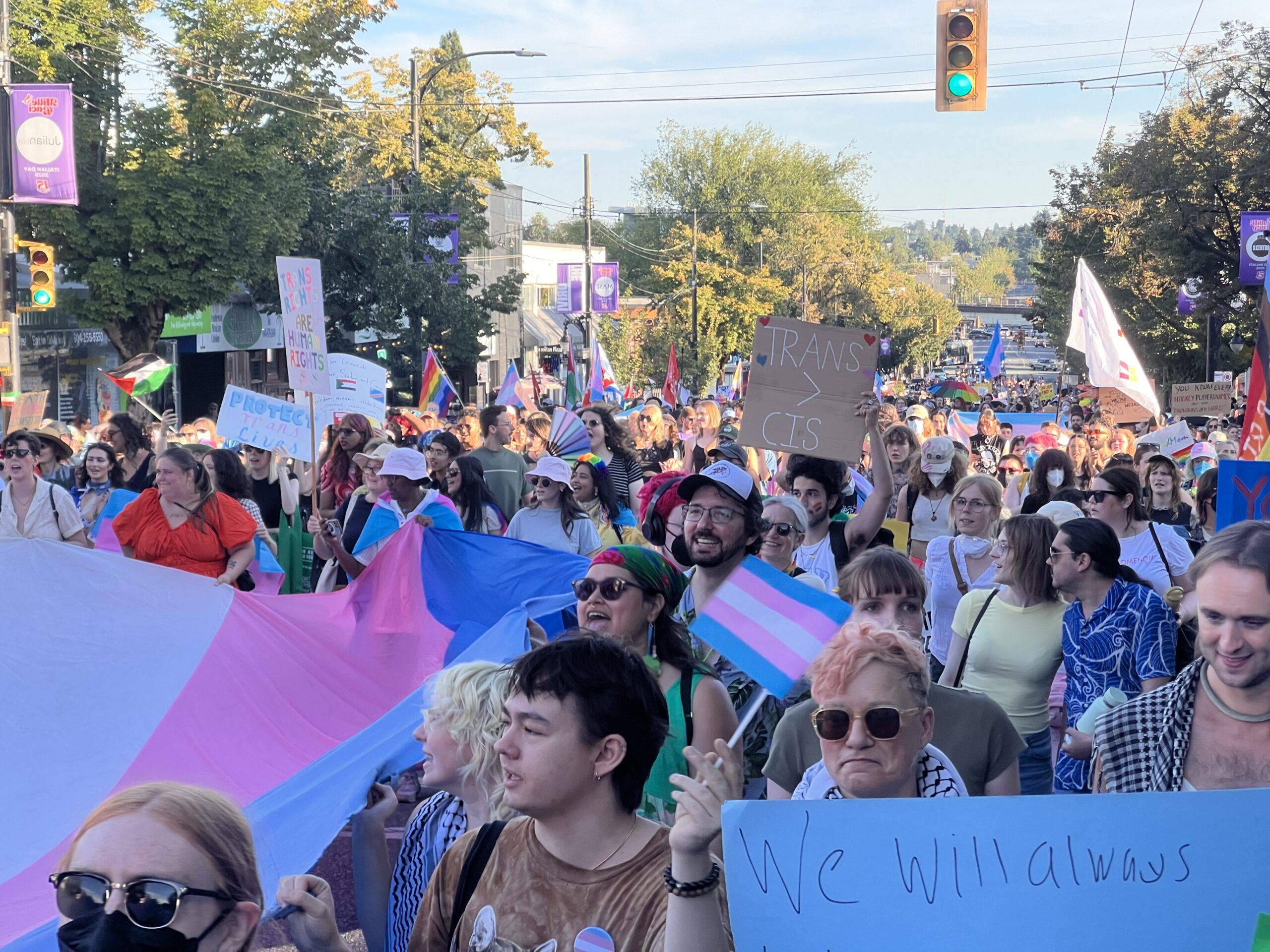 CIS"." data-uniqueid="145753-151488" data-guid="https://celeste.lgbt/wp-content/uploads/2026/03/IMG_7115-scaled.jpg" data-path="2026/03/IMG_7115-scaled.jpg" data-width="2560" data-height="1920" data-singlew="8.4" data-singleh="" data-crop="" data-fixed="" />
In fourth place: British Columbia
In a dramatic escalation beginning fall 2025, British Columbia has seen the highest number of anti-trans bills in Canada. So far, I’ve been able to track down five of them (on top of two such bills prior to July 2025), all defeated at first reading:
- Protecting Minors from Gender Transition Act (8 Oct. 2025; defeated 40-48)
- Post-Secondary Institutions Diversity, Equity and Inclusion Prohibition Act (19 Nov. 2025; defeated 41-50)
- Public Flags Display Act (25 Nov. 2025; defeated 15-73)
- Gender Ideology and Child Protection Act (19 Feb. 2026; defeated 38-49)
- Human Rights Code Repeal Act (26 Feb. 2026; defeated 37-50)
These bills stand out from much of what’s going on elsewhere in Canada in three respects. First and foremost, the bills are thrown like shit on the window: they are introduced by fringe MLAs (most notably independent MLA Tara Armstrong and OneBC MLA Dallas Brodie). Second, they are moribund by the simple fact that the B.C. NDP and Greens have consistently opposed those bills at first reading, a practice they have reserved for bills that serve nothing but patent discrimination. Yet, third and most significantly, these bills go significantly further than their counterparts anywhere else in Canada.
Tara Armstrong’s Protecting Minors from Gender Transition Act is a copy-paste of U.S. model anti-trans legislation created by anti-LGBTQ+ hate group Do No Harm. It also is the first-ever use of the notwithstanding clause in the B.C. legislature. The Gender Ideology and Child Protection Act goes further by deeming affirming trans youth to be child abuse. The Public Flags Display Act is a flag ban bill, introduced explicitly to ban Pride, trans, and Palestine flags. And perhaps, most concerning, the Human Rights Code Repeal Act — a first of its kind in Canada, of which I couldn’t even find an equivalent in the United States of America — outright repeals every single anti-discrimination protection applicable in British Columbia.
Given the less-than-a-snowball’s-chance-in-hell possibility of these bills passing, yet the B.C. NDP still having passed legislation in the past disproportionately affecting trans people, forbidding some of them from changing their names for life, B.C. is maintained at a moderate risk level.
A notable improvement: Nova Scotia
Nova Scotia’s risk level has been lowered to “no reason to fear”, owing to its 2SLGBTQIA+ Action Plan, which contains a great number of positive commitments — such as a commitment to improve gender-affirming healthcare pathways. For a province under a conservative government, this is a surprising yet positive development — and easily the most significant positive development I can mention in the present update.
The Territories
The Northwest Territories has been re-classified as a medium risk jurisdiction, given real issues caused by lack of continuity of access to gender-affirming healthcare — a knock-on effect from Alberta’s anti-trans legislation.
Nunavut has been classified as a medium risk jurisdiction. This is subsequent to the fact that it is the last Canadian jurisdiction to implement a non-binary gender on birth certificates. three years after Québec — and when debating the implementation of said gender marker, 8 MLAs (out of 20 present) voted against, citing the bathroom predator myth. Just like in B.C., it’s too close to comfort for me to argue that there’s no reason to fear potential anti-trans developments.
I was debating whether the Yukon should face an increased risk level because a right-of-centre government (the Yukon Party) was elected. So far, I’ve no reason to fear: the Yukon Party has committed to Queer Yukon (the main queer organization there) that it’ll continue working on its next 2SLGBTQIA+ Inclusion Action Plan. This might be me being overly hopeful, but I’m hoping that all will turn out alright.
The federal government
My main concern with the federal government, for the time being, remains Bill C-12 — which effectively is the successor legislation to Bill C-2. It would allow revocation of immigration status, including mass revocations, under dubious “public interest” grounds. It would prohibit most potential refugee claimants from claiming asylum if they cross into Canada from the U.S. — despite the fact that there have been accepted refugee claims from trans U.S. citizens in Canada — and will bar any such claim from someone who’s been in Canada for more than one year — a provision which particularly affects trans migrants, who in many cases come out once in Canada. Migrant rights and civil liberties groups are rightfully concerned.
The Carney government has equally announced that it is exploring the possibility of a social media ban for young people. I remain concerned about the possibility of age verification propositions and other such measures which could disproportionately affect trans people without ID, on top of breaching their right to privacy — as well as the general implications of denying queer and trans youth access to resources. We’ll only know for sure where this will lead us if/when a bill comes out.
In the meantime, given Bill C-12, the federal government continues with its “medium risk with warning” qualifier.
…and the rest of Canada
No particular news has occurred out of Ontario, which remains a medium risk jurisdiction primarily because premier Doug Ford has previously hinted at parental rights discourse back in 2023 – and has not ruled out using the notwithstanding clause either (in general).
Manitoba remains a safe jurisdiction for trans people. The Constitutional Questions Amendment Act, forcing a reference to the Manitoba Court of Appeal for any Manitoba bill which passes with the notwithstanding clause, is a very good sign for a government committed to protecting trans people (and Charter rights at large).
Given that nothing makes me fear that PEI will have anti-trans developments anytime soon, its risk level has been decreased. Ibid for New Brunswick and Newfoundland, which are maintained as “no reason to fear”.
Methodology
Each jurisdiction is rated using qualitative measures, being notably the reach and severity of anti-trans legislation and government (provincial/territorial) policy, as well as what local political parties are discussing. Both the policies of the current party in power, the ones of any opposition parties with a certain likelihood of forming government, and polling for upcoming elections (with a higher weight going to imminent elections) are evaluated whilst qualifying a jurisdiction’s level of safety.
Any bill, policy, or law which intentionally harms a significant proportion of the trans community, or a socio-political climate favorable to making such legislation pass prior to or soon after the next elections, will bump a jurisdiction to ‘high risk’. The ‘worst anti-trans laws’ qualifier is reserved for jurisdictions which either ban gender-affirming care for trans youth, forcibly out trans youth to their parents, or otherwise has a combination of anti-trans laws and policies creating a climate so hostile to trans people that it would be analogous to a ‘worst jurisdiction’ under Erin Reed’s map.
On the other side of the spectrum, the ‘no reason to fear’ qualifier means what it means: I’ve got no reason to fear that any anti-trans developments will occur anytime soon. Jurisdictions that don’t fall either under this definition or the definition of “high risk” are categorized as “medium risk”.
Given that more porous nature of Canadian federalism than American federalism (for example, the Canadian federal government controls criminal law all across the country, unlike the U.S., where both states and the federal government have jurisdiction), “shield laws” per se can’t really exist in Canada, but any steps taken by a given government to defend trans people will be taken into account.
Everything's at stake
I wish I wasn't exaggerating.
But everything for us is at stake right now.
Four days ago, for the first time in Canadian history, a member of a legislature proposed a bill to repeal an entire Human Rights Code. And 36 other members of said legislature voted for the same. BC MLA Tara Armstrong attempted to introduce Bill M233, the Human Rights Code Repeal Act, which outright repeals the B.C. Human Rights Code and abolishes the B.C. Human Rights Tribunal.
Here's a copy of Hansard for convenience's sake:
Bill M233 — Human Rights Code Repeal Act
Tara Armstrong presented a bill intituled Human Rights Code Repeal Act.
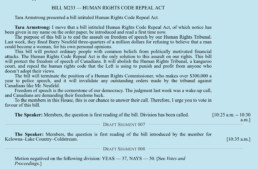
Tara Armstrong: I move that a bill intituled Human Rights Code Repeal Act, of which notice has been given in my name on the order paper, be introduced and read a first time now.
The purpose of this bill is to end the assault on freedom of speech by our Human Rights Tribunal. Last week, they fined Barry Neufeld three-quarters of a million dollars for refusing to believe that a man could become a woman, for his own personal opinions.
This bill will protect ordinary people with common beliefs from politically motivated financial attacks. The Human Rights Code Repeal Act is the only solution to this assault on our rights. This bill will protect the freedom of speech of Canadians. It will abolish the Human Rights Tribunal, a kangaroo court, and repeal the human rights code that the Left is using to punish and profit from anyone who doesn’t adopt their views.
The bill will terminate the position of a Human Rights Commissioner, who makes over $300,000 a year to police speech, and it will invalidate any outstanding orders made by the tribunal against Canadians like Mr. Neufeld.
Freedom of speech is the cornerstone of our democracy. The judgment last week was a wake-up call, and Canadians are demanding their freedoms back.
To the members in this House, this is our chance to answer their call. Therefore, I urge you to vote in favour of this bill.
[Division was called. 37 voted YEA: the BC Conservatives, as well as MLAs Brodie (OneBC), Kealy (ind.), and Armstrong (ind., ex-OneBC). 50 voted NAY, including the BCNDP and BC Greens. Bill defeated.]
It's fortunate that this bill didn't make it anywhere close to third reading. Yet, what this bill entails is horrifying. This would mean that an employer could refuse to serve someone for being Black (just like in Christie v. York Corporation, a 1939 Supreme Court of Canada case upholding "freedom of contract"). It would mean that a business owner can refuse to sell their business to a woman because they are a woman. It means that a landlord can refuse to rent to someone because they're Indigenous. And of course, it would mean that dehumanizing speech against trans people — speech that can make a workplace untenable or even lead to incitement to genocide, as exemplified so well in Chilliwack Teachers' Association v. Barry Neufeld (No. 10) — will face no sanction by the State.
If the notwithstanding clause is a five-alarm fire, this is even more unprecedented. It means regressing back to a vision of Canada consisting solely of a white, male, able-bodied, cisgender and heterosexual class that gets to participate in society, and everyone else, left by the wayside.
Human rights are the foundational building block of the post-World War II legal order. They exist in order to prevent some of the worst crimes against humanity ever documented from ever reoccurring — including domestic crimes against humanity here in Canada, such as the internment of Japanese Canadians, the Chinese Exclusion Act and the genocide of Indigenous peoples through residential schools. We can't let human rights erode. It's a matter of defending each and every one of us' dignity.
Yet, this isn't isolated. The callous disregard for human life and human dignity can be seen across the world. Last week, Kansas (USA) took away the drivers' license and birth certificate of every single one of its trans citizens, only permitting said IDs to contain sex assigned at birth — an obvious marker of transness — officially making trans people second-class citizens, akin to how the Nazis did so with Jewish people's passports in 1938. And just over the weekend, the United States and Israel decided to launch an offensive war against Iran — one obviously motivated by imperialist interests more than anything else.
Everything is indeed at stake for us now. To pretend otherwise is to live in a fictitious wonderland which doesn't exist.
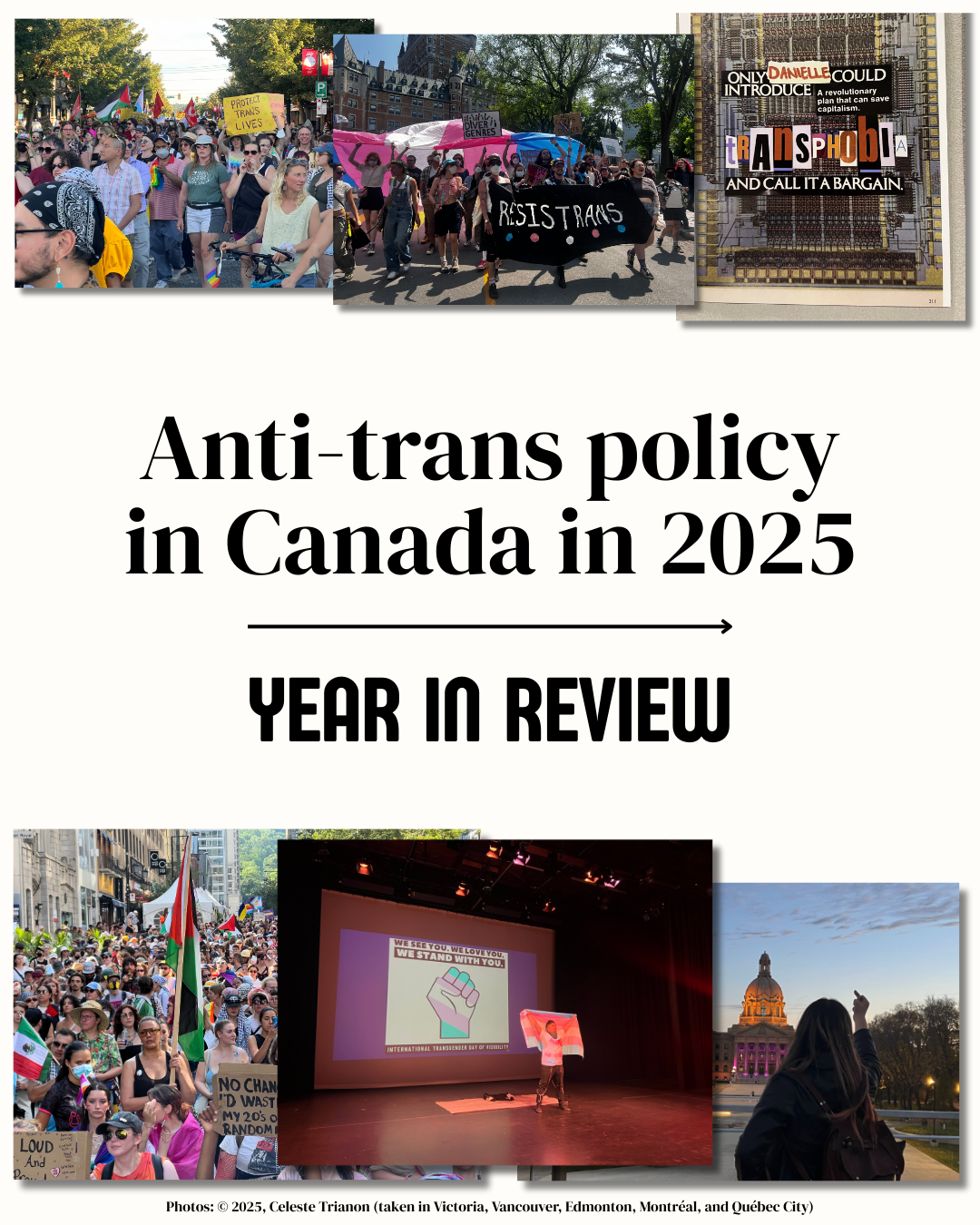
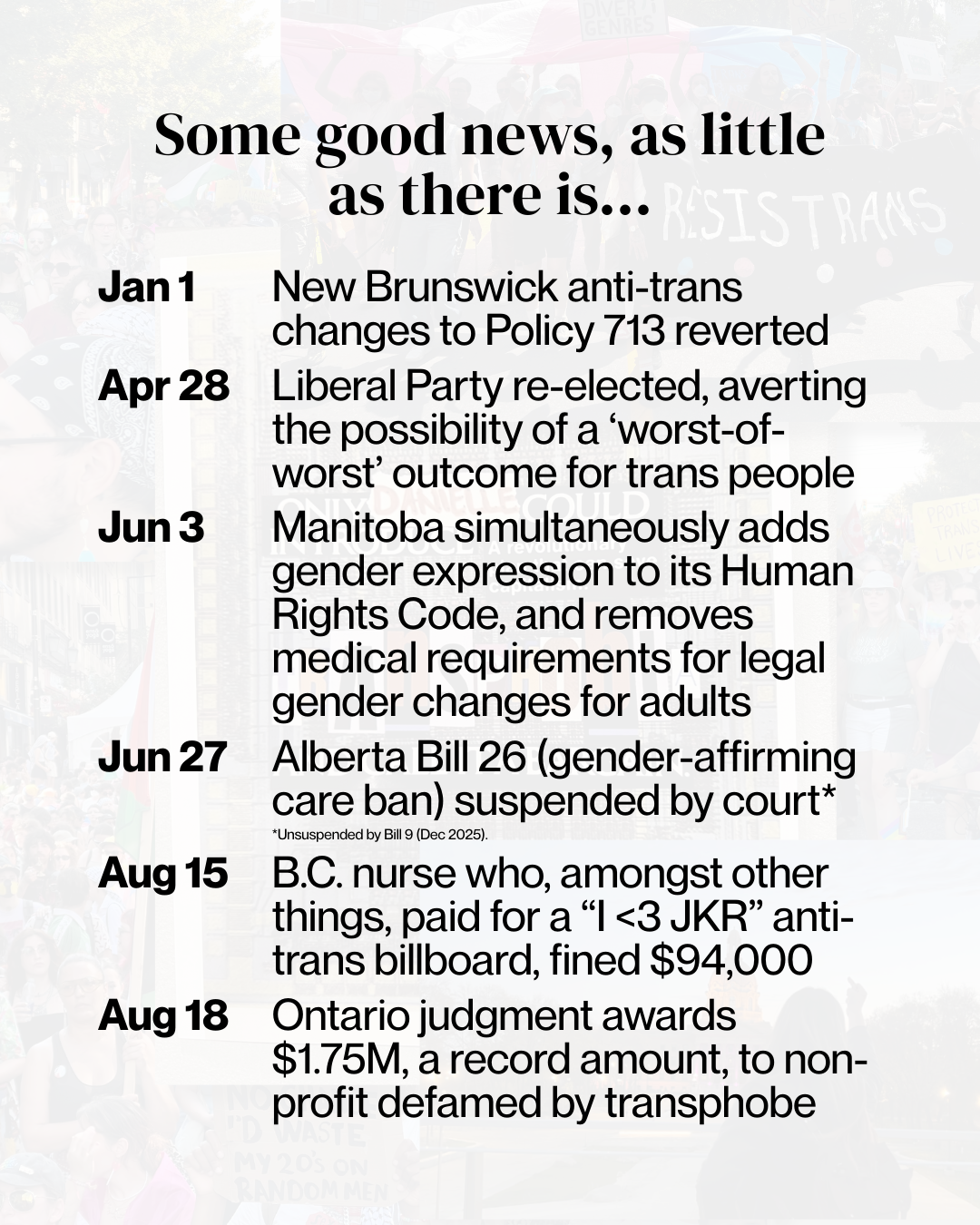
2025 in Canadian anti-trans law and policy: a year in review
If there’s one way to summarize what 2025 has been like for trans people in Canada, it’s that shit’s been going down. Anti-trans laws have truly evolved from fringe idea to a core part of right-wing policy-making — despite the fact that lives are at stake. Here is a summary of how things have evolved in 2025.
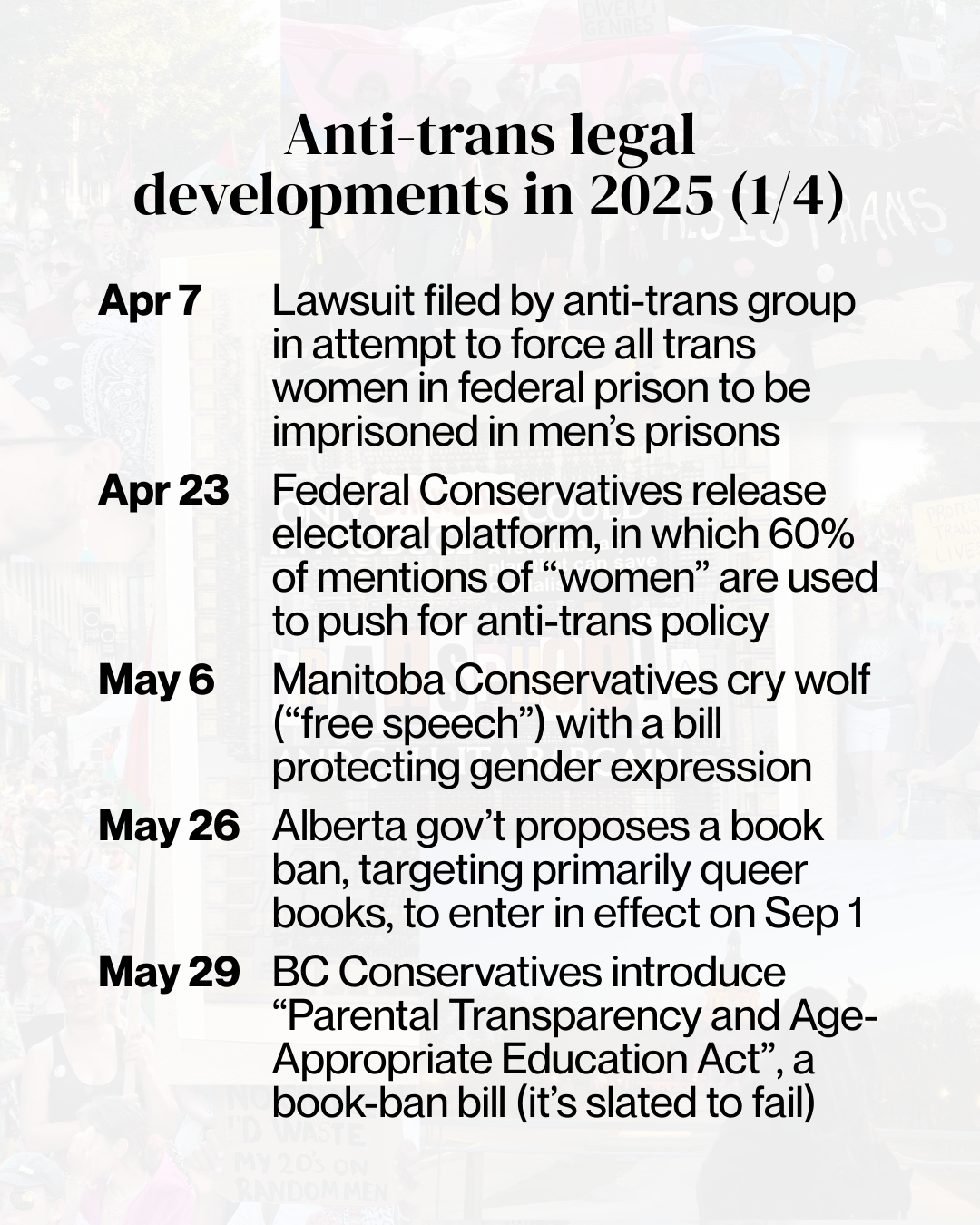
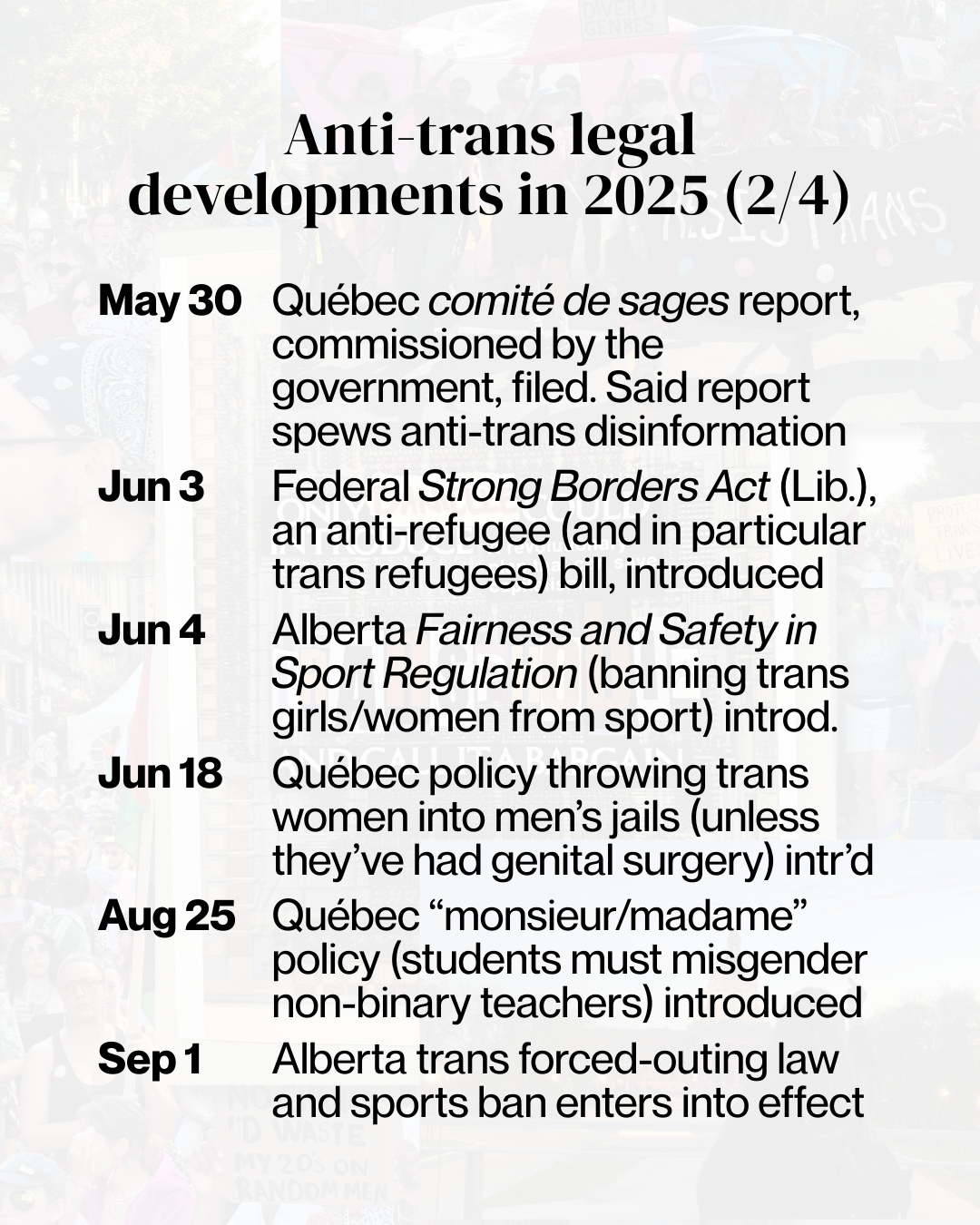
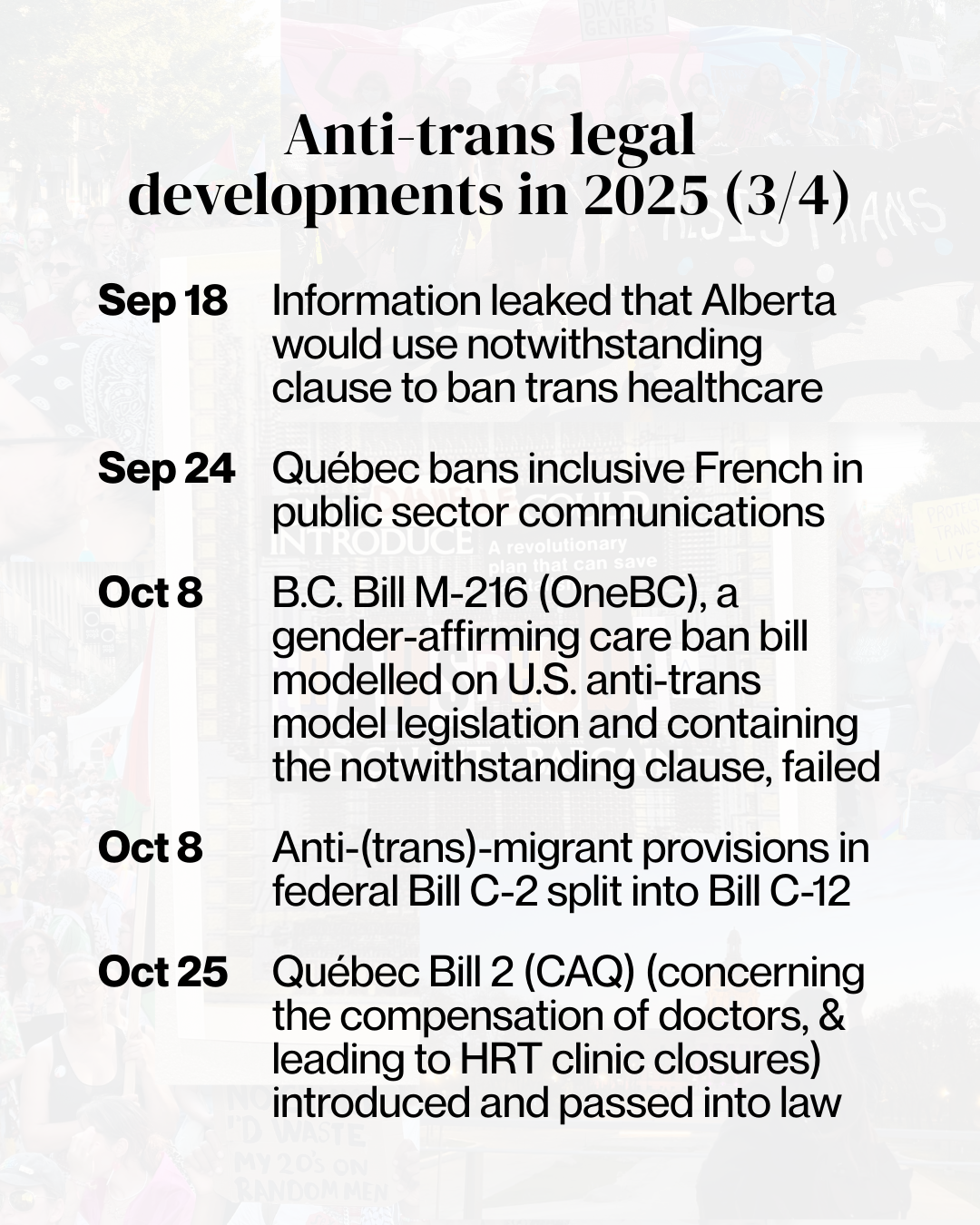
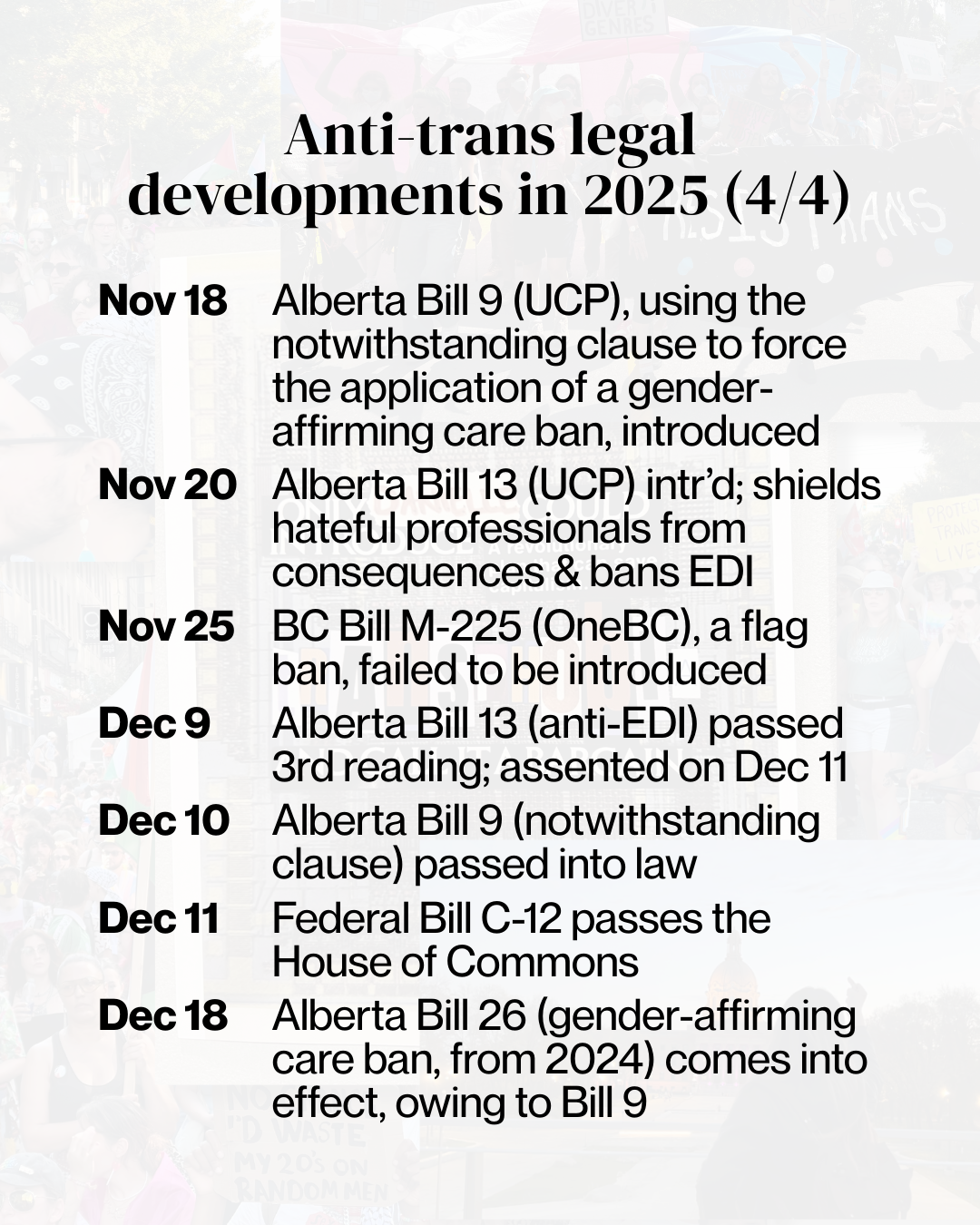
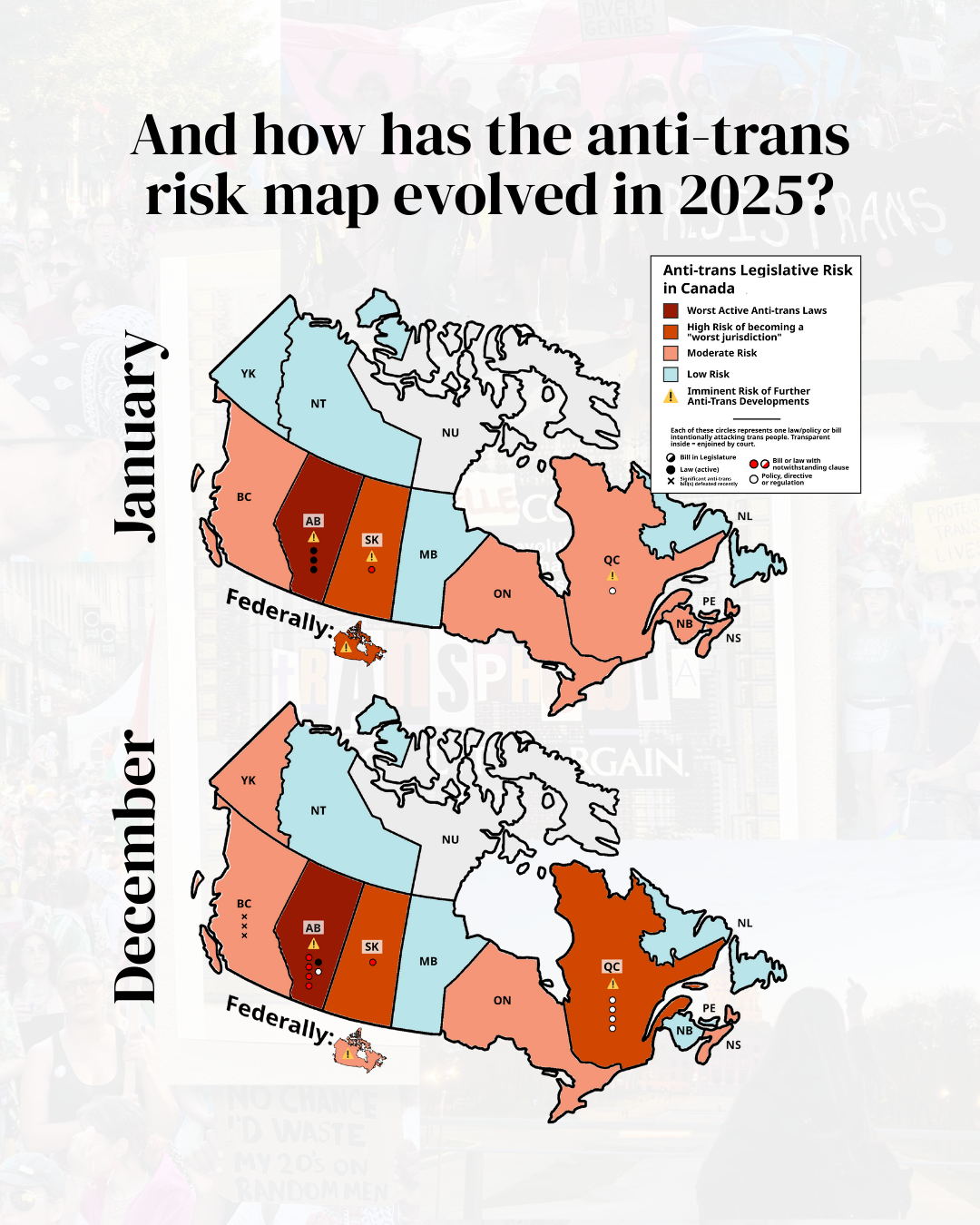
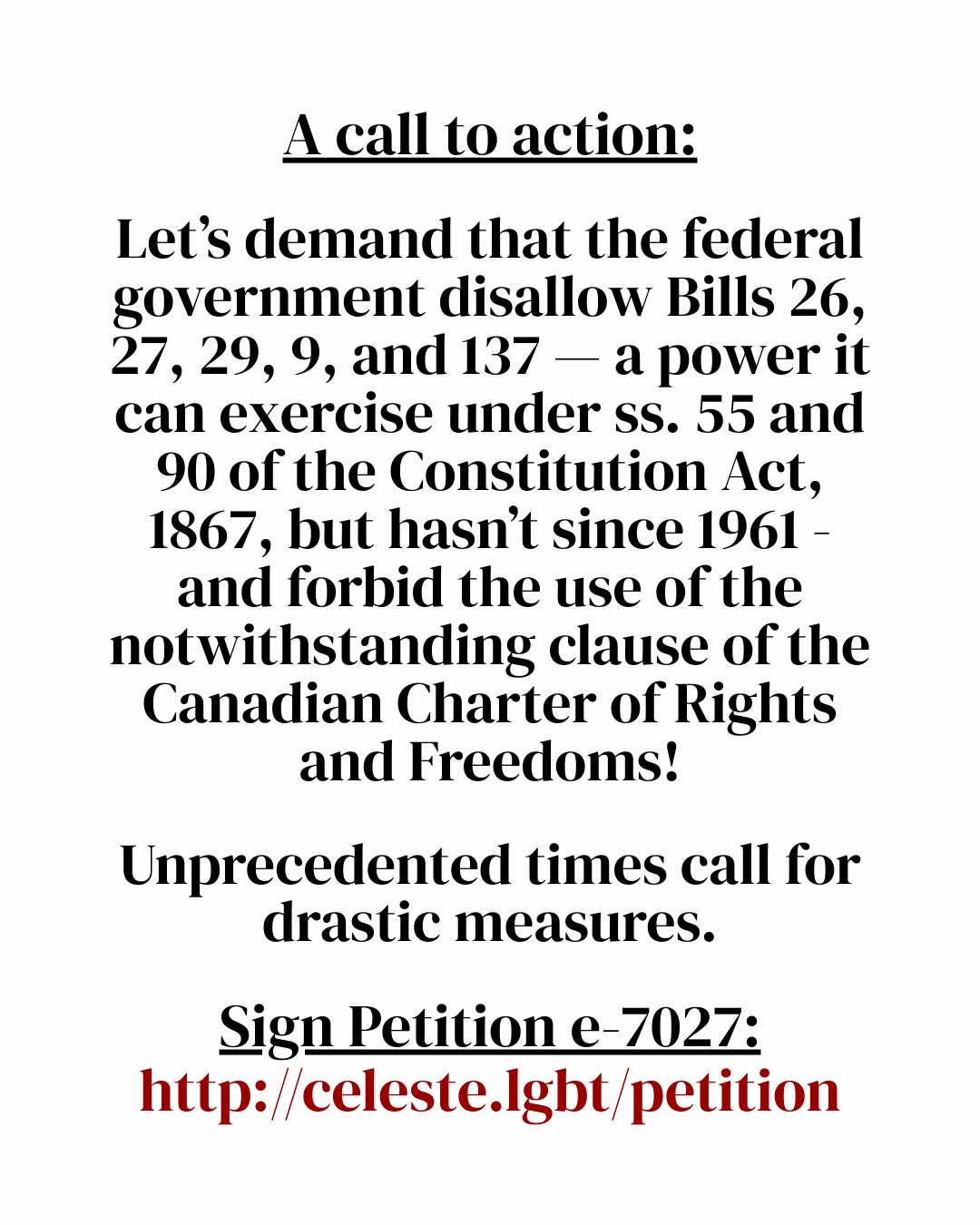
| Date | What happened |
|---|---|
| April 7, 2025 |
Lawsuit filed by anti-trans groups in attempt to force all trans women in federal prison (serving 2+ year sentences) to be imprisoned in men’s prisons |
| April 23, 2025 |
Federal Conservative Party releases electoral platform, in which 60% of mentions of “women” are used to push for anti-trans policy |
| May 6, 2025 |
Manitoba Conservatives cry wolf, playing the “free speech” card, against a Manitoba NDP bill protecting gender expression |
| May 26, 2025 |
Alberta UCP government proposes a book ban, targeting primarily queer books (such as Gender Queer), to enter in effect at the beginning of the school year |
| May 29, 2025 |
BC Conservatives introduce “Parental Transparency and Age-Appropriate Education Act”, a book-ban bill (though it is bound to fail on the order paper) |
| May 30, 2025 |
Québec comité de sages report, commissioned by the government, filed. Said report spews anti-trans disinformation throughout |
| June 3, 2025 |
Federal Strong Borders Act (Bill C-2), an anti-refugee (and in particular trans refugees) bill, introduced by the Liberal Party |
| June 4, 2025 |
Alberta Fairness and Safety in Sport Regulation (banning trans girls/women from sport) introduced |
| June 18, 2025 |
Québec policy throwing trans women into men’s jails (unless they’ve had genital surgery) introduced |
| August 25, 2025 |
Québec “monsieur/madame” policy (forcing students to misgender non-binary teachers for 'civics' reasons) introduced |
| September 1, 2025 |
Alberta trans forced-outing law, trans women sports ban, and sex ed ban enters into effect; book ban modified to only attack queer graphic novels |
| September 18, 2025 |
Information leaked that Alberta would use notwithstanding clause to ban trans healthcare |
| September 24, 2025 |
Québec bans inclusive French in public sector communications |
| October 8, 2025 |
B.C. Bill M-216 (OneBC), a gender-affirming care ban bill modelled on U.S. anti-trans model legislation and containing the notwithstanding clause, introduced and failed at first reading |
| October 8, 2025 |
Anti-(trans)-migrant provisions in federal Bill C-2 split into Bill C-12 |
| October 25, 2025 |
Québec Bill 2 (CAQ) (concerning the compensation of doctors, & leading to HRT clinic closures) introduced and passed into law. Clinic closures are slated for 2026 |
| November 18, 2025 |
Alberta Bill 9 (UCP), using the notwithstanding clause to force the coming-into-effect of a gender-affirming care ban, introduced |
| November 20, 2025 |
Alberta Bill 13 (UCP) introduced. It shields hateful professionals from professional consequences, and bans mandatory equity, diversity and inclusion training by professional regulators |
| November 25, 2025 |
BC Bill M-225, a OneBC bill banning Pride and trans flags (in particular), failed at first reading |
| December 9, 2025 |
Alberta Bill 13 passes third reading |
| December 10, 2025 |
Alberta Bill 9 passes third reading |
| December 11, 2025 |
Federal Bill C-12 passes the House of Commons |
| December 18, 2025 |
Alberta Bill 26 (trans youth healthcare ban) comes into effect, after Bill 9 is used to reverse an injunction blocking said bill |
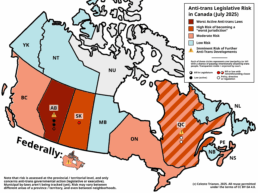
July 2025 Canadian Anti-Trans Risk Assessment Map
Update (March 2026): This map has been updated. Read the latest update here!
We’re halfway across 2025, a year which already is living in infamy as a year of attacks and rollbacks against trans people’s human rights. In Canada, despite some positive developments, we’re not exactly spared from it either. The risk of anti-trans developments remain, in particular in Canadian jurisdictions where right-of-centre governments are in power. Yet, there is reason for hope, especially as some provinces take a stance of leadership which is desperately needed in these rough times.
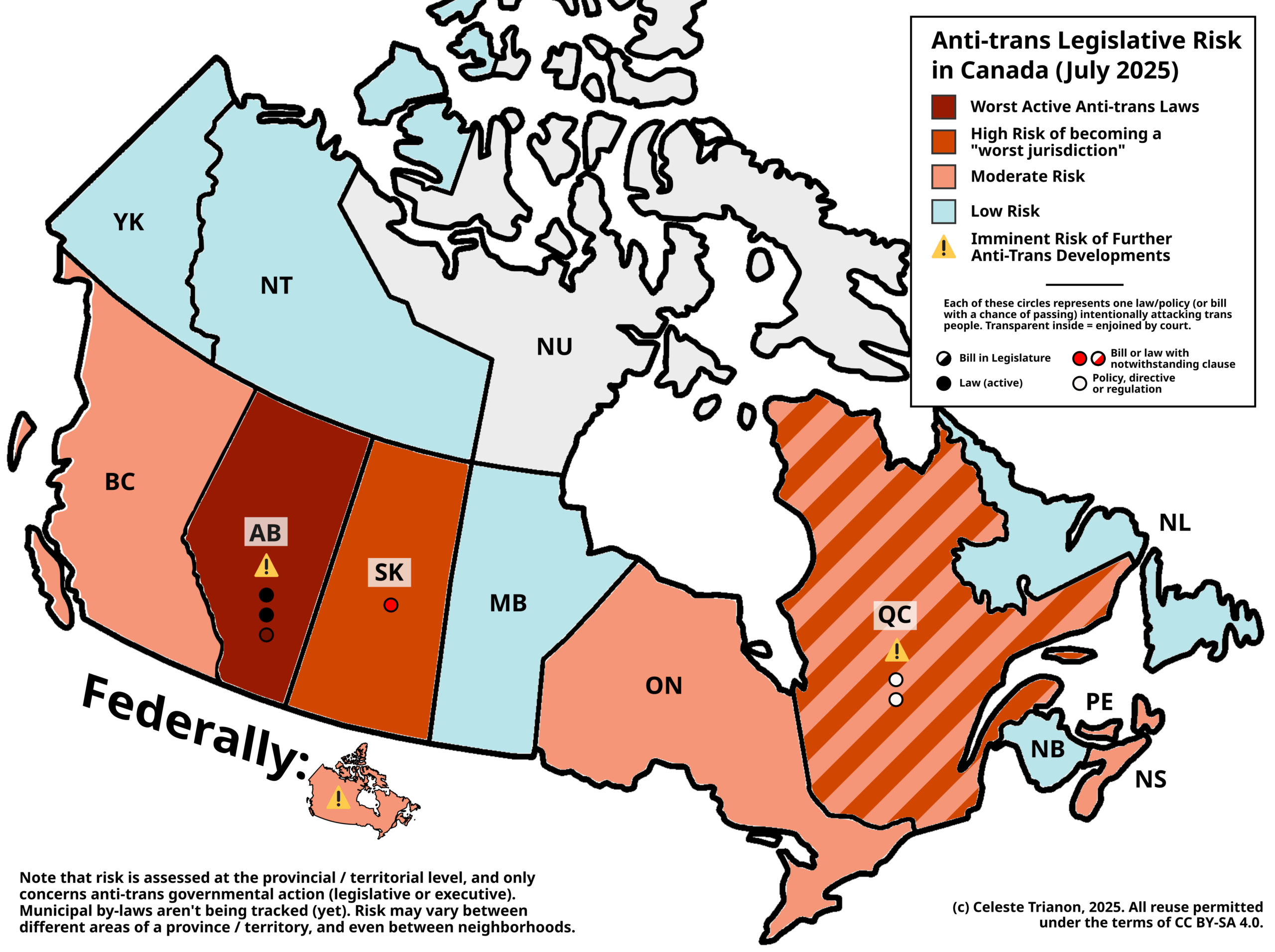
Changes since January 2025
- Federal: High risk with warning → Medium risk with warning
- Québec: Medium risk with warning → Medium/High risk
- New Brunswick: Medium risk → Low risk
About this map
Since I began tracking anti-trans developments in Canada (as early as 2021, when I was fighting against the initial iteration of Québec Bill 2), I’ve had people ask me: “I’m planning on moving to Canada, where should I move?”. This question, unfortunately, has been asked to me way too many times since January 2025, when Donald Trump seized power in the United States: promptly, our southern neighbours have become a no-go zone for trans people, with hundreds of thousands of internally displaced persons and (increasingly) refugees and de facto refugees. This question is equally relevant to trans Canadians themselves, as well as other trans migrants, who wish to be able to live and thrive in an environment where their existence isn’t consistently questioned.
I created my original anti-trans risk map in September 2023, inspired off of Erin Reed’s anti-trans risk map, as an exercise in visualizing anti-trans hate across Canada. At the time, nationwide protests against trans participation in public life were taking place, and Saskatchewan would become the second Canadian jurisdiction introducing such measures — whilst my home province of Québec promised to introduce its own homegrown brand of government-administered hate, a development which just occurred back in June.
Anti-trans legislation in Canada, whilst taking forms that are different from the U.S., remain similar: examples include gender-affirming care bans, Pride flag bans, and forced outing laws. Legal strategies used to defend such inhumane laws are almost equivalent. The influences behind anti-trans groups, both foreign-funded and domestically grown, are so marked that the Canadian Security Intelligence Service had to publish its own warning.
My focus is on documenting risk for both trans youth and adults, with the assumption that both are correlated. Most anti-trans legislation (and anti-2SLGBTQ+ legislation at large), within the Canadian context, either targets trans youth (targeting them either because they are under the age of majority, or because they are attending school) or trans women (see: transmisogyny).
New to this update: this map also divides anti-trans legislation into two categories: legislation with anti-trans intent (where the law is motivated by anti-trans animus), and legislation with anti-trans effect (laws which have a disproportionate effect on trans people, for instance a name change ban for people with criminal records). Whilst my focus is still on the former (which will be recorded using dots on the map itself), this change allows for bills and laws that will clearly jeopardize the well-being of trans people, such as BC’s Name Amendment Act No. 2 (2024) and the federal Strong Borders Act, to nonetheless face the criticism they deserve.
Note that this map only tracks legislated hate, and not the relative safety of different communities for trans folk across Canada. The unfortunate truth is that it’s extremely difficult to map out, say, the occurrence of hate crimes or other forms of hate. Do not rely on this map as a sole gauge of the state of transphobia in Canada; there are a lot of minute details which I simply cannot capture in one map!
Methodology
First and foremost, all jurisdictions are presumed to be of ‘moderate risk’. This should be understood as the default, and already takes into account the generalized social climate of anti-trans hate in Canada. From there, I rate each jurisdiction using qualitative measures, being notably the reach and severity of anti-trans legislation, as well as what the local Conservative Party (or equivalent) is discussing. Both the policies of the current party in power, the ones of any opposition parties with a certain likelihood of forming government, and polling for upcoming elections (with a higher weight going to imminent elections) are evaluated whilst qualifying a jurisdiction’s level of safety.
Any bill, policy, or law which actively harms a significant proportion of the trans community, or a socio-political climate favorable to making such legislation pass prior to or soon after the next elections, will bump a jurisdiction to ‘high risk’. The ‘worst anti-trans laws’ qualifier is reserved for jurisdictions which either ban gender-affirming care for trans youth, forcibly out trans youth to their parents, or otherwise has a combination of anti-trans laws and policies creating a climate so hostile to trans people that it would be analogous to a ‘worst jurisdiction’ under Erin Reed’s map.
On the other side of the spectrum, the ‘low-risk’ qualifier is reserved for jurisdictions which have either created policies and proposed & implemented laws supporting trans well-being, or shown to be willing to actively defend trans youth. Given that more porous nature of Canadian federalism than American federalism (for example, the Canadian federal government controls criminal law all across the country, unlike the U.S., where both states and the federal government have jurisdiction), “shield laws” per se can’t really exist in Canada, but any steps taken by a given government to defend trans people will be taken into account.

The worst jurisdiction: Alberta
Alberta continues to be the only Canadian jurisdiction to get the “worst anti-trans laws” label attached to it, for two main reasons: Alberta Bills 26 and 27, a ban on gender-affirming healthcare and a forced outing bill respectively. The latter also serves as a de facto sex ed ban.
Bill 26 has been temporarily enjoined in court, thanks to the efforts of Skipping Stone and Égale Canada, which launched a court challenge the day after the bill received royal assent. The Canadian Medical Association has also launched its own lawsuit over said bill. However, the Alberta government has both shown its intention to appeal said judgment, and use the notwithstanding clause — a move deemed “cruel and unnecessary” by Amnesty International Canada. Other moves by the United Conservative Party, the far-right party governing Alberta, includes drag bans, gender marker change bans, and further leeway for on-campus hate speech — moves which suggest that Alberta will not back down, no matter what the Canadian Charter of RIghts and Freedoms states.
Bill 27 has not been challenged in court thus far, but would likely face such a challenge in the months to come.
One another law targeting trans people in Alberta is active right now: Bill 29, a sports ban. Its regulations (and therefore, implementation), specify that any female athlete, age 12 and up, must be able to prove that they were “born female” to play; forces sports organizations, including recreational ones and ones who wish to stay inclusive, to implement a policy stating as such; and allows for vigilantes to challenge any female athlete’s sex assigned at birth, a measure that will inevitably lead to more transphobia both through the systematic exclusion of trans women, and the creation of a broader environment of “gender policing” that’ll affect all women athletes.
Finally, Pride flag bans implemented by the towns of Westlock and Barrhead back in 2024 remain active.
In second place: Saskatchewan
Saskatchewan continues to stand in the “high risk” category. Its unprecedented use of the notwithstanding clause of the Canadian Charter of Rights and Freedoms in Bill 137, a mechanism shielding laws from judicial review for breaches of fundamental freedoms as simple as the right to life, liberty and security of the person to impose a forced outing bill, cannot be understated. Trans youth will inevitably struggle in school owing to this law, as they face the risk of prejudice (though not forced outing). Even though Scott Moe, leader of the Saskatchewan Party, has backed down on his proposal to institute a change room ban for trans youth “on day one” in reaction to a news story about two trans girls using the changing room, Moe has demanded that every school have a publicly available policy on the matter — something which can shape things either for the better or for the worse.
It remains that there is a risk of further anti-inclusion legislation being introduced there, depending on the moral panic of the day.
In third place: Québec
Québec remains a bit of a wildcard, being culturally distinct from much of the rest of Canada. However, it has seen a marked and significant rise of government-approved anti-trans hate which warrants an increase in risk level — though, not yet to the same extent as Saskatchewan. The Québec Ministry of Education, since May 2024, requires that all new public school bathrooms be gendered — a measure introduced in the wake of public backlash against a teacher using “Mx.” as a title. Students in schools are also now required to use “Madame” or “Monsieur” (Ms. or Mr.) to address their teachers in school — a policy perhaps not with anti-trans intent, but clearly with an anti-trans effect.
The Québec government’s Comité de sages sur l’identité de genre, an advisory committee on trans people composed of three cisgender non-experts, has silently released a flawed report enabling anti-trans voices under the cover of anonymity. The Québec government itself has publicly stated its approval of said report. Perhaps even worse: the Québec government has undertaken steps beyond what said committee has stated — notably introducing a trans prisoner segregation policy, separating trans prisoners by genitalia in spite of there only being six (6) trans prisoners in Québec provincial jails (the report itself recommended a case-by-case approach with guidelines based on sincerity, amongst other criteria).
I have reasons to believe that the Québec government could introduce worse legislation, as stated in my article regarding said report, and corroborated by this new prisoner policy. Given the state of current polling in Québec favouring the Parti Québécois, a formerly left-leaning party which has since been claimed by “anti-woke” nationalists, I have little hope to believe things will improve unless massive changes occur during the next year.
Medium risk: in particular, B.C., Ontario, Nova Scotia, and the federal government
First and foremost, the federal government — this is going to be a long one.
A Carney win is absolutely a non-loss for trans rights. I cannot describe it as a “win”, but it certainly means that trans rights will be safer than what it would have been under a Conservative government — especially given Poilievre’s obsession over repealing CD 100, a directive merely allowing trans prisoners to request to be transferred to a prison corresponding with who they are, and prior suggestions of banning gender-affirming healthcare, imposing bathroom bans, and other forms of extreme anti-trans legislation similar to what’s being implemented in the United States.
However, this doesn’t mean we’re out of the blue. First, the current Liberal government has shown a propensity to work with the Conservatives on passing bills that would make Stephen Harper salivate — demonstrated in particular with Bill C-5. However, what concerns me the most is Bill C-2, the so-called “Strong Borders Act” — a bill which I would describe both as draconian, and one with profoundly anti-trans effects.
Bill C-2 demolishes the right to asylum in Canada. Instead of giving asylum seekers the opportunity for a fair and impartial hearing — a right protected by the Canadian Charter of Rights and Freedoms — it guts that right altogether in many cases, replacing it with “pre-removal risk assessments” without procedural fairness guardrails. It prevents people who have been in Canada for over a year from claiming asylum — a provision which particularly affects trans and 2SLGBTQ+ migrants, who oftentimes only face the need to make an asylum claim after coming out in Canada, oftentimes more than a year after stepping into the country. It reinforces the so-called “Safe Third Country Agreement” with the United States, despite the fact that the U.S., apart from being an unsafe country for trans people (where trans folks are actively fleeing), is literally building concentration camps as I type these words out. It’s a bill which isn’t motivated by anti-trans animus, but in its effects, will devastate the lives of trans migrants — putting them at danger of persecution abroad, in a time when the world is only further shrinking for trans folks because of anti-trans hate.
Now, onto the provinces.
B.C. was, for the longest time, a little sea of blue — and of relative safety — for trans people. However, that is not the case. The B.C. NDP, which currently still holds power by a razor-thin margin, has, prior to the elections in October 2024, introduced and passed legislation disproportionately affecting trans people, forbidding some of them from changing their names for life (unlike similar laws in the rest of Canada allowing ministerial discretion in granting name changes). The B.C. Conservatives, on the other hand, has repeatedly spewed misinformation and disinformation about trans people, advocated for further restrictions on trans well-being, has attempted to introduce anti-trans legislation prior to the last election and since, even going as far as to create an entire opposition portfolio for attacking trans people under the guise of “parental rights” — yet, for some opposition MLAs, isn’t enough. It’s impossible to tell right now if B.C. is going to stay relatively calm for the next few years, or is going to end up becoming dangerous for trans folks living there.
Ontario amended, in a little-publicized move at the tail end of 2024, its Change of Name Act to restrict people having been convicted from a yet-to-be-determined list of criminal offenses from changing their names. except if requested “to prevent significant harm to the person to whose name the application relates”. This is, at first glance, less strict than B.C.’s Name Amendment Act. However, whether the Ontario Attorney General understands that name changes are necessary for trans people to prevent significant harm still remains to be determined. What’s to come is tough to determine. On one hand, Ontario Bill 5 remains a significant power-grab by the government, and may be a harbinger of what’s to come in case anti-trans hate ends up further normalized in said province. On the other hand, the Ontario government dropped its appeal in K.S. v O.H.I.P., allowing a broader set of gender-affirming surgeries to be covered by Ontario’s public health insurance plan.
Nova Scotia deserves to be commended for improving access to gender-affirming care, in particular in rural areas thereof. However, other bills — for instance, a bill granting Nova Scotia’s PCs the right to fire the auditor general — remain a cause for concern for potential rollbacks to come, in particular if a populist tide is pushing towards further gutting trans rights in the province. For now, Nova Scotia’s presumptive “medium risk” rating remains.
I do not have news to share regarding PEI, which also remains “medium risk” for the time being.
Low risk: Manitoba, New Brunswick, Newfoundland, the Northwest Territories and Yukon
Manitoba deserves a gold star for its defense of trans rights. I don’t use the same “safest states” rating the same way Erin Reed does, but if I had a “safer province” classification, I would use it here. Manitoba Bill 26 finally abolishes medical letter requirements for gender marker changes, a significant barrier to access to justice and to day-to-day life for trans Manitobans, whilst Bill 43 finally adds gender expression as a protected grounds in its Human Rights Code. Wab Kinew’s government has also been providing explicit support for trans community in the face of anti-trans hate. Whilst the Change of Name Amendment Act (No. 2), passed by the Manitoba Legislature in 2024, will create new barriers to legal name changes in the future, said law isn’t yet in effect, and contains provisions for ministerial exemption (making it less bad than B.C.’s equivalent law). Overall, in spite of this last negative development, Manitoba seems to be overall on a great track — and as such, is a safe jurisdiction for trans people.
New Brunswick has been adjusted to “low risk”, given the lack of negative developments in said province, and overall safe(r) legislative climate created by the Holt government.
Whilst I do not have significant updates for the Northwest Territories, it remains that trans youth living could still face additional barriers to care if Alberta chooses to appeal in Egale Canada v Alberta, since many NWT communities depend on Alberta to access gender-affirming healthcare.
I have no updates to provide regarding Newfoundland and the Yukon, which remain safe for the time being. Additionally, I do not have enough data to report on Nunavut, hence why it’s greyed out.

Vote, for the sake of our futures
Vote, for the sake of our futures.
The federal election on Monday, April 28, 2025 will be a day of reckoning for many of us living here in Canada. It's an election that has been, purportedly, about the economy, about the housing crisis, about rising grocery prices, price gouging, and more — yet never has so much been at stake. We've seen, over the last few months, relentless attacks on Canada's very sovereignty and continued existence by an expansionist, colonialist power in the south. And here at home, we're seeing the same strategies — hateful rhetoric, attacks towards minorities, and attempts to appear "tough" at the cost of destroying our democracy.
I'm terrified for our futures.
The Conservatives have made anti-trans campaigning an important part of their messaging. The last three years have seen a never-before-seen increase in anti-trans rhetoric in Canada, in great part metastasized from the U.S. and abroad. Hate groups have taken root here, using their power and deep wallets in an attempt to pit people against each other — leading to hundreds of hate protests across the country, and legislation attacking the rights and freedoms of trans youth in two Canadian provinces. Poilievre's promise to endanger trans women in prisons — and simultaneous failure to introduce any measures concretely protecting women — is telling. He does not want to protect Canadians; merely punish them. Law and order, as in "obey and abide". Sounds Trumpian, doesn't it?
Constitutional protections are equally being eroded as we speak. As section 15 of the Canadian Charter of Rights and Freedoms turns 40, the very idea of equality rights — one of the very principles underlying Canadian law in the last 40-60 years — is starting to slip away. Saskatchewan, Ontario, and Québec have already chipped away at Canadians' human rights, one at a time; whether it'd be with trans youth, unionized workers or hijab-donning teachers. Poilievre's suggestion to expand its use to the federal level would send it straight to its deathbed. To quote The Globe and Mail columnist Andrew Coyne, "He’s picked the perfect starting point, of course. There can be few less sympathetic figures than multiple murderers." Yet, we live in a society where everyone, by virtue of being alive, are deserving of dignity and of humanity. To dispose of this idea would be to turn back the clock fifty years, and to plunge us into a new dark age — one where Japanese-Canadians were expropriated and forcibly relocated, one where Indigenous kids were scooped away from their parents, one where we couldn't necessary fall in love with the persons we love.
Is that the future that we deserve? Is that the future that you want?
Our political parties have been far from perfect. Some have, arguably, been horrible — and in a way, have allowed our current status quo, one of generalized disenfranchisement, to take root. But none have shown so much contempt towards humanitarianism as one of them: the Conservatives. They've allowed disinformation campaigns in their name to take hold. They're teaming up with DOGE wannabes to destroy this country. They're talking about attacking trans women, denying healthcare for trans kids. They're calling on defunding humanitarian organizations such as UNRWA, and defunding universities which doesn't align with his values. They're talking about defunding Canada's public broadcaster, about womens' "biological clocks". Poilievre himself is calling Nazis "socialists" instead of what they are: Nazis. That doesn't smell like democracy to me; that sounds like authoritarianism — because Trumpism is fascism is authoritarianism.
We shouldn't live in a society in which every election — and the times preceding it — are times filled with uncertainty and fear, yet that's exactly what it's like to be a trans woman in Canada in 2025. And I don't want us to end up like the U.S. — a country from which people are actively fleeing owing to authoritarian laws and policies. I don't want us to end up that way.
So please — don't Trump Canada.
Whether you think your vote will make a difference or no, vote as if your life depends on it — because it does.
* * *
Read more about different federal political parties' positions on 2SLGBTQ+ issues on Queer Momentum's website.
For strategic voting, look up 338canada.com and VoteWell.
For ridings in which the Conservatives have no chance of winning, look up VotePalestine — we don't need just a strong wave of votes against fascism, but also strong leftist opposition MPs able to hold a (hopefully) Carney government to account.
For information on how to vote: Elections Canada.
January 2025 Canadian Anti-Trans Risk Assessment Map
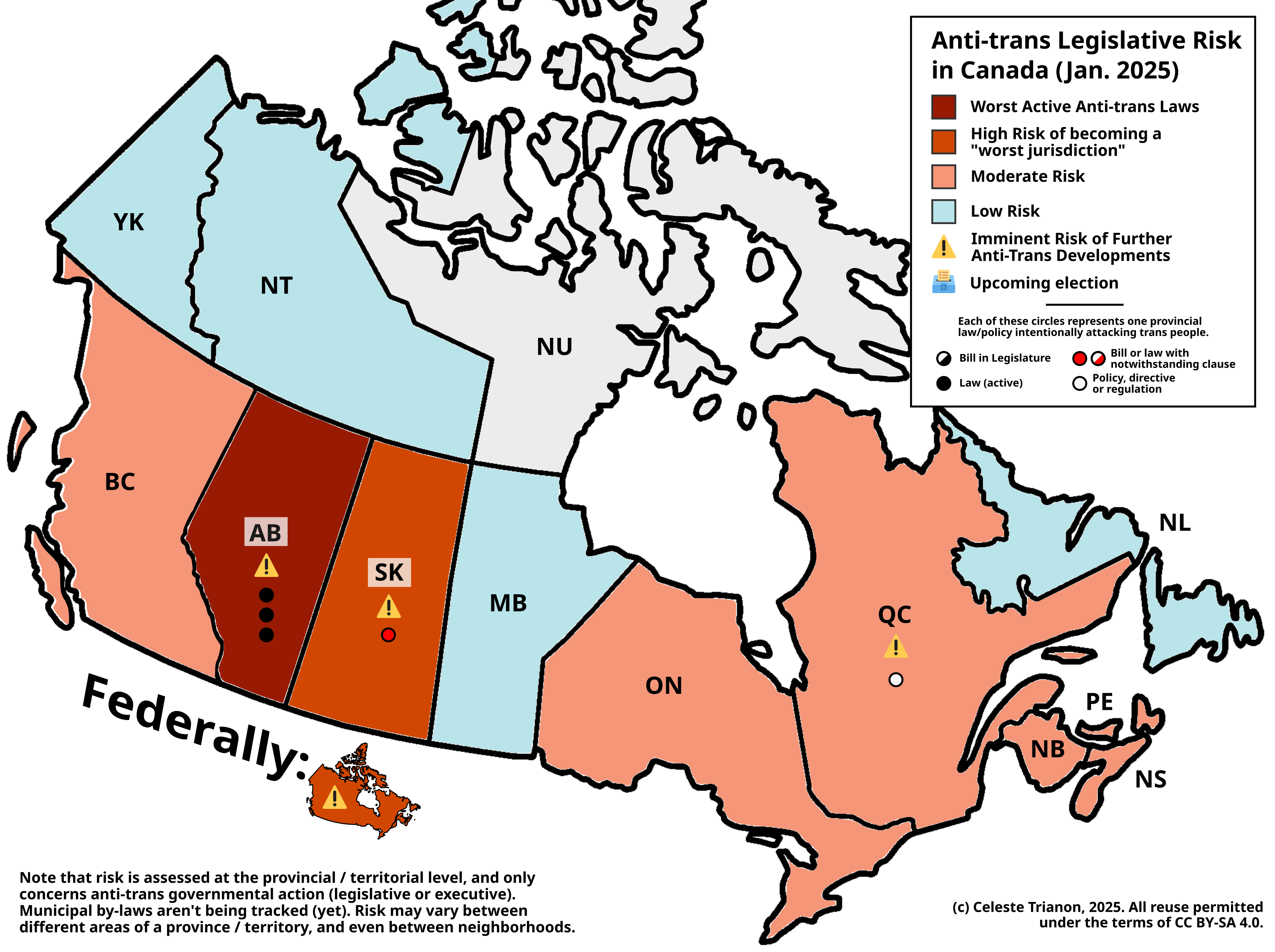
I’m going to be very honest: 2025 is not going to be a good-looking year for trans people in Canada. The biggest reason why? The federal Conservatives. The risk of further anti-trans developments in Canada, especially at the federal level and in transphobic jurisdictions (such as Alberta), is at an all-time high, especially considering the imminent risk of a federal election that would likely spell disaster for trans people living in the Great White North.
An updated version of this map was published on July 3rd, 2025. This page is kept here for archival purposes.
About this map
Since I began tracking anti-trans developments in Canada (as early as 2021, when I was fighting against the initial iteration of Québec Bill 2), I’ve had people ask me: “I’m planning on moving to Canada, where should I move?” I’d also get similar questions from people who are considering moving within Canada owing to an anti-trans climate — sometimes as simple as parents seeking to enroll their trans kids in another school for their safety, in other cases people seeking move between entire provinces because of hateful legislation and policy.
I created my original anti-trans risk map in September 2023, inspired off of Erin Reed’s anti-trans risk map, as an exercise in visualizing anti-trans hate across Canada. At the time, nationwide protests against trans participation in public life were taking place, and Saskatchewan would become the second Canadian jurisdiction introducing such measures — whilst my home province of Québec promised to introduce its own homegrown brand of government-administered hate.
Anti-trans legislation in Canada, whilst taking forms that are different from the U.S., remain similar: examples include gender-affirming care bans, Pride flag bans, and forced outing laws. The influences behind anti-trans groups, both foreign-funded and domestically grown, are so marked that the Canadian Security Intelligence Service had to publish its own warning.
Unlike Erin Reed’s map, I focus on documenting risk for both trans youth and adults, with the assumption that both are correlated. Most anti-trans legislation (and anti-2SLGBTQ+ legislation at large), within the Canadian context, either targets trans youth (targeting them either because they are under the age of majority, or because they are attending school) or trans women (see: transmisogyny). If the status quo in Canada becomes one in which trans adults are targeted differently than trans youth, I will split the map in two.
Methodology
First and foremost, all jurisdictions are presumed to be of ‘moderate risk’. This should be understood as the default, and already takes into account the generalized social climate of anti-trans hate in Canada. From there, I rate each jurisdiction using qualitative measures, being notably the reach and severity of anti-trans legislation, as well as what the local Conservative Party (or equivalent) is discussing. Both the policies of the current party in power, the ones of any opposition parties with a certain likelihood of forming government, and polling for upcoming elections (with a higher weight going to imminent elections) are evaluated whilst qualifying a jurisdiction’s level of safety.
Any bill, policy, or law which actively harms a significant proportion of the trans community, or a socio-political climate favorable to making such legislation pass prior to or soon after the next elections (which encompasses, in this case, the federal Conservative Party), will bump a jurisdiction to ‘high risk’. The ‘worst anti-trans laws’ qualifier is reserved for jurisdictions which either ban gender-affirming care for trans youth, forcibly out trans youth to their parents, or otherwise has a combination of anti-trans laws and policies creating a climate so hostile to trans people that it would be analogous to a ‘worst jurisdiction’ under Erin Reed’s map.
On the other side of the spectrum, the ‘low-risk’ qualifier is reserved for jurisdictions which have either created policies and proposed & implemented laws supporting trans well-being, or shown to be willing to actively defend trans youth. Given that more porous nature of Canadian federalism than American federalism (for example, the Canadian federal government controls criminal law all across the country, unlike the U.S., where both states and the federal government have jurisdiction), “shield laws” per se can’t really exist in Canada, but any steps taken by a given government to defend trans people will be taken into account.
The worst jurisdiction: Alberta
Alberta is the only Canadian jurisdiction to get the “worst anti-trans laws” label attached to it, for two main reasons: Alberta Bills 26 and 27, a ban on gender-affirming healthcare and a forced outing bill respectively. The latter also serves as a de facto sex ed ban.
In addition, another law and two by-laws targeting trans people are active in Alberta right now: Bill 29 (a sports ban, including at the recreational level), and Pride flag bans implemented by the towns of Westlock and Barrhaven respectively. All of said pieces of legislation and delegated legislation (municipalities being governed by provincial law in Canada) were introduced in 2024.
As a quick reminder: gender-affirming care is medically necessary and saves lives. The prospect of these anti-trans bills existing have already taken at least one life in Alberta, and probably many more.
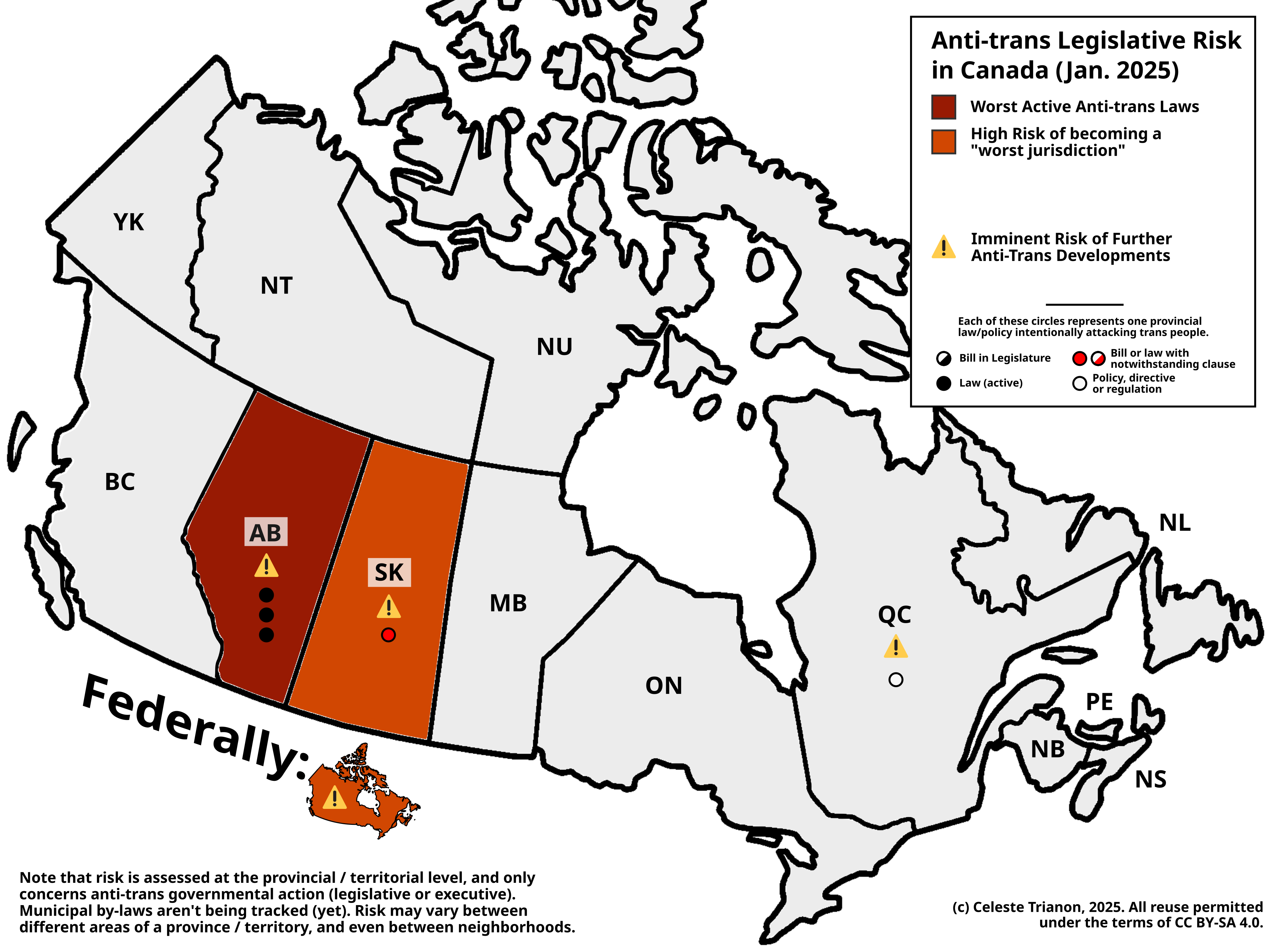
High risk: Canada’s federal government and Saskatchewan
The federal government of Canada gets a high risk rating for one reason, and one reason only: the Conservative Party of Canada (CPC), and its leader, Pierre Poilievre.
Pierre Poilievre is the type of person that would hang around, and do supra-hour-long interviews with some of Canada’s most noted transphobes (ahem, Jordan Peterson, the same guy who got famous opposing Canada’s federal gender identity protection bill, C-16, and has referred to a non-binary city councillor in tweets as an “appalling self-righteous moralizing thing“). He tries to pretend not to be anti-abortion, despite being rated as anti-choice by the Abortion Rights Coalition of Canada, and sits comfortably around anti-abortion advertising and legislation. Seeing the correlation between anti-abortion and anti-trans laws (both by their modus operandi and the people supporting them), it’s impossible for me to assume anything but bad faith from him.
Pierre Poilievre is also the same person who has spoken out against trans women in, ahem, women’s bathrooms, and has suggested instituting a bathroom ban, calling trans women “biological men”. Y’know, the same rooms so many trans people try to avoid at all costs, and the same term used so often to demean trans people whilst dismissing them for who they are? That’s on the table for him. He’s also more recently spoken out against trans women merely requesting to be transferred to a women’s prison — something that’s often too necessary for trans prisoners to avoid cruel and unusual treatment (that often doubles as an additional sentence), such as V-coding.
Poilievre’s Conservative colleagues cannot be trusted either. Melissa Lantman, MP for Thornhill (part of the Greater Toronto Area), formerly an ardent defender of queer people within the Conservative Party, called Poilievre’s statement “the position of the Conservative Party, and the common sense Conservative position”. His colleague Michelle Rempel Garner, Calgary Nose Hill MP and also a former defender of queer people from within tbe CPC, literally ran away from the Hill Times’ journalist attempting to question her on the issue. In both cases, it seems said women’s prior work on the matter seems to have been for nothing; considering that they were the closest allies we’ve ever had in said party, it’s likely that no one from the CPC will stand up for trans rights in Canada.
It doesn’t help that the CPC’s membership has passed explicitly anti-trans party resolutions less than two years ago, and that Poilievre has increasingly used the dogwhistle “gender ideology” to refer to trans people’s very existence. And that’s without discounting the fact that Poilievre has literally denied the existence of racism. All of this is nothing short of shameful, yet the Conservative government is very likely going to be reelected with a sweeping majority this year. Scary, eh?
As for Saskatchewan, its use of the notwithstanding clause of the Canadian Charter of Rights and Freedoms, a mechanism shielding laws from judicial review for breaches of fundamental freedoms as simple as the right to life, liberty and security of the person to impose a forced outing bill, cannot be understated. Scott Moe, leader of the Saskatchewan Party, had also suggested instituting a change room ban for trans youth “on day one” in reaction to a news story about two trans girls using the changing room. This has yet to come true, but would likely push Saskatchewan ever closer to becoming a “worst jurisdiction” for trans youth in Canada.
Medium risk: in particular, B.C., Ontario, Québec, and New Brunswick
B.C. was, for the longest time, a little sea of blue — and of relative safety — for trans people. However, that is not the case. The B.C. NDP, which currently still holds power by a razor-thin margin, has, prior to the elections in October 2024, introduced and passed legislation disproportionately affecting trans people, forbidding some of them from changing their names for life (unlike similar laws in the rest of Canada allowing ministerial discretion in granting name changes). The B.C. Conservatives, on the other hand, has repeatedly spewed misinformation and disinformation about trans people, advocated for further restrictions on trans well-being, has attempted to introduce anti-trans legislation prior to the last election, even going as far as to create an entire opposition portfolio for attacking trans people under the guise of “parental rights”. It’s impossible to tell right now if B.C. is going to stay relatively calm for the next few years, or is going to end up becoming dangerous for trans folks living there.
Ontario recently amended, in a little-publicized move, its Change of Name Act to restrict people having been convicted from a yet-to-be-determined list of criminal offenses from changing their names. except if requested “to prevent significant harm to the person to whose name the application relates”. This is, at first glance, less strict than B.C.’s Name Amendment Act. However, whether the Ontario Attorney General understands that name changes are necessary for trans people to prevent significant harm remains to be determined.
I don’t have any further legislative updates to share regarding Ontario, but there’s been some action as of late. First, London, Ontario is allowing anti-trans ads calling for a gender-affirming care ban to be run on its municipal buses, claiming it does not violate the Canadian Charter of Rights and Freedoms. This is a direct copy of similar tactics used by anti-abortion groups, which have repeatedly attempted to get their ads placed wherever they can. In addition, the anti-trans 18-year-old Josh Alexander — notorious for organizing several anti-trans protests in Ottawa, an for attending a particularly notorious one in June 2023 — saw his school suspension, initially issued for harrassing trans youth at his school, upheld — a positive development for trans youth needing protection from increasingly virulent teenagers, in particular misogynistic teenage boys.
Québec remains a bit of a wildcard, being culturally distinct from much of the rest of Canada. However, it is not spared from the influence of anti-trans hate. The Québec Ministry of Education, since May 2024, requires that all new public school bathrooms be gendered — a measure introduced in the wake of public backlash against a teacher using “Mx.” as a title. The Québec government’s Comité de sages sur l’identité de genre, an advisory committee on trans people composed of three cisgender non-experts, is still undertaking its work, and will come out with its report by the end of March. I suspect that whichever hateful measures end up being adopted next by the Québec government will be the ones recommended by said committee, if not any.
Finally, New Brunswick is the only province with positive recent developments. Following the October election of Liberal premier Susan Holt, and the incumbent PCNB’s failure to get re-elected, New Brunswick has since allowed abortions to be performed outside hospitals, and has reversed course on Policy 713, allowing trans youth to go by their chosen names and pronouns without having to forcibly out themselves to their parents. This alone isn’t enough for me to bump down New Brunswick to “low risk”, since these changes remain bandages fixing what the previous Higgs government did. One thing remains certain though: New Brunswick is, for now, on the right track.
Other medium-risk jurisdictions are PEI and Nova Scotia, where I do not have much additional news to share.
Low risk: Manitoba, Newfoundland, the Northwest Territories and Yukon
There’s not much to note here. The worst developments in Manitoba and Newfoundland are recent laws tightening up the name change process, but which provide for ministerial discretion and exceptions, unlike B.C.’s Name Amendment Act and the Ontario Change of Name Act. How these laws will be applied remains to be determined. As for the Northwest Territories, trans youth living there now face additional barriers to care, since they’re no longer able to go to Alberta (which is geographically closest for many NWT communities!) to access gender-affirming healthcare.
Note that my risk assessments for Canada’s territories are limited, owing to limited data and the fact that it is safer to be trans in some communities than others. That’s why Nunavut is grayed out: I’d rather not report than report inaccurately!
Opinion: Trans people are scared. Canada needs to act.
Republished from the Toronto Star, where this opinion piece I wrote was first published. Read the original: https://www.thestar.com/opinion/contributors/trans-people-are-scared-canada-needs-to-act/article_f99f6648-108b-5790-94c1-b36a23366f34.html
Over the last few decades, every major study regarding gender identity has shown that gender-affirming care has significant therapeutic benefits. Medical associations listened and updated their guidelines accordingly. However, I have watched in horror as, over the past few years, science has taken the back burner; for many, ideology trumps fact.
In Missouri, attorney general Andrew Bailey issued an emergency order, effectively banning gender-affirming health care for all people needing it — adults included. Out in Florida, lawmakers are attempting to remove child custody over parents listening to the science. Many trans people — and their families alike — have resorted to fleeing their homes, in the face of state-sanctioned anti-trans policies. Countless advocates have pleaded to state legislatures, but to no avail: instead of listening, they’ve been censoring the very politicians challenging their ideology. “Free speech for me, not for thee.”
Attacks against gender variance aren’t new. Almost exactly 90 years ago to the day, the Institut für Sexualwissenschaft — the world’s first modern sexology institute, pioneering trans health care — was burned by the Nazis. Knowledge and lives were lost, but trans, non-binary and Two-Spirit people didn’t stop existing: we went into hiding.
We’re not safe here in Canada either. Recently, Quebec Conservative Party leader Éric Duhaime introduced an anti-drag petition, garnering over 40,000 signatures. Protests against gender nonconformity at large have exploded across the country these last twelve months; drag defence, similarly to abortion clinic defence, has become an unfortunate necessity.
School boards are facing backlash for being inclusive, and law societies are being brigaded by actors fighting against so-called “gender ideology.” Friends are writing to me stating that they’re feeling unsafe. It’s a dark sign of what’s to come.
So, why aren’t we doing more to counter this tsunami of hate? We’re currently at an inflection point — either Canada can become a safe haven where gender diversity is accepted, or trans people will no longer have anywhere else on the planet to flee.
To avoid past mistakes, we need to start taking proactive action. Our statutes and courtrooms need to become shields against the dismantling of our civil liberties. Our governments need to create concrete action plans — seawalls — to stop hate from being imported here.
The onslaught against trans people worldwide will soon bring over its number of refugees. I believe it is our moral duty to welcome those fleeing from abroad. We’ve been, for a long time, recognized as a leader for 2SLGBTQ+ rights: it’s time for us to reinforce said commitment and transform perception into reality.
It’s in times of crisis that leadership truly shines. With the current attacks against gender variance in the U.S., U.K., Uganda and elsewhere, we have a unique opportunity to set ourselves apart, for the better. Do we double down on our constitutional, Charter principles — including the protection of minorities and the right to equality — or do we abandon them for good, sitting on a maple-gilded ivory tower? The choice is ours.